Try, learn and adjust
Check what procurement information firms receive
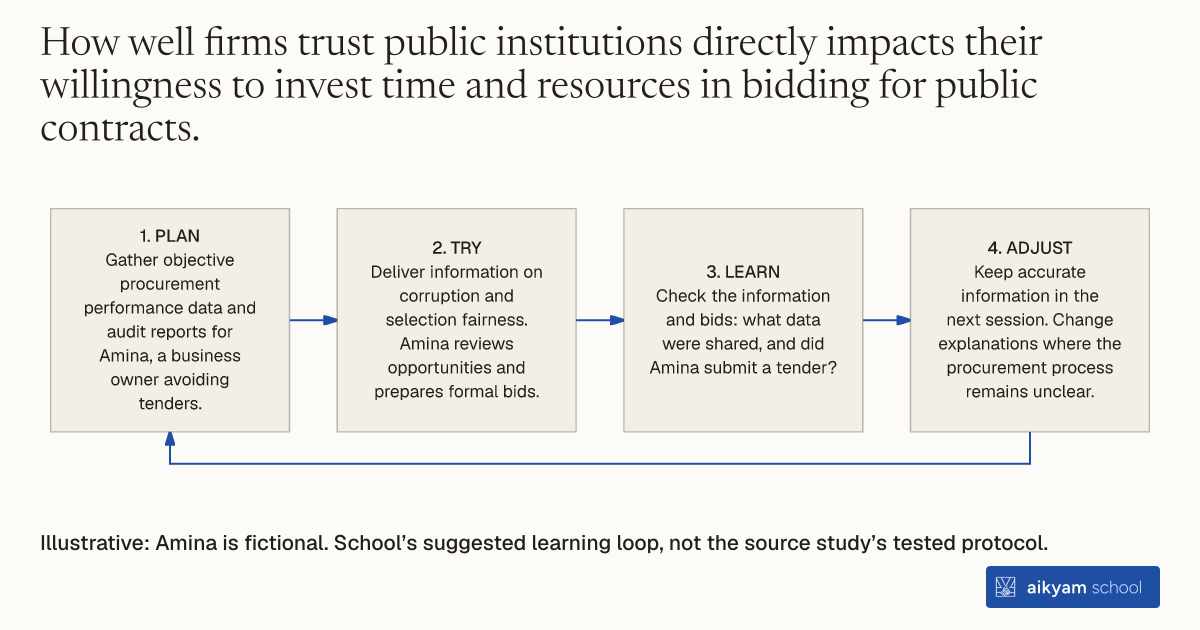
- Plan: Gather objective procurement performance data and audit reports for Amina, a business owner avoiding tenders.
- Try: Deliver information on corruption and selection fairness. Amina reviews opportunities and prepares formal bids.
- Learn: Check the information and bids: what data were shared, and did Amina submit a tender?
- Adjust: Keep accurate information in the next session. Change explanations where the procurement process remains unclear.
Illustrative: Amina is fictional. School’s suggested learning loop, not the source study’s tested protocol.
See source →School’s suggested, untested loop. Observe information delivered and bid submissions; no tender win is assumed.
How
When to use
Small and medium enterprises in low- and middle-income countries often refrain from bidding on public contracts because they believe the selection process is corrupt. This mistrust creates an information friction that reduces market competition and limits small business growth. Providing managers with accurate information about public procurement procedures encourages local businesses to participate in government tenders.
Correct firm owners' misperceptions about government corruption to increase bidding on public procurement contracts.
- Public procurement authorities or researchers identify small and medium enterprises that avoid bidding on public tenders.
- Program administrators gather objective performance data and transparent auditing reports regarding public procurement processes.
- Facilitators deliver targeted information sessions to business owners providing accurate data on corruption and selection fairness.
- Managers reassess the expected fairness of government contracting and identify open public tender opportunities.
- Participating firms prepare and submit formal bids for government tenders.
Why it works
Dispelling false corruption perceptions reduces perceived risk, leading firms to participate in and win government tenders.
Example
In Uganda, improving firms' perceptions about government corruption led small and medium businesses to bid on and win more government tenders.
About the study
Participants
Small and medium enterprises eligible for public procurement contracts in Uganda.
Study Design
Field experiment (RCT) evaluating firm tender participation following information interventions on public sector corruption.
Results
Improving firms' perceptions regarding government corruption increased the rate at which businesses submitted bids and won government tenders.