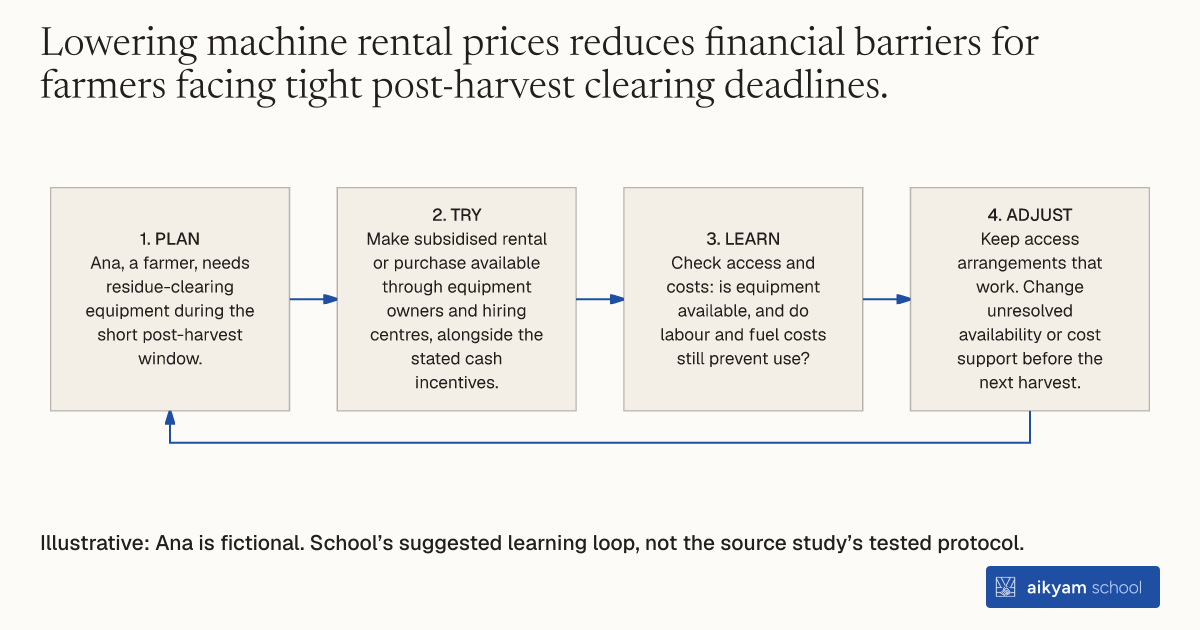
Try, learn and adjust
Check access to non-burning machinery
- Plan: Ana, a farmer, needs residue-clearing equipment during the short post-harvest window.
- Try: Make subsidised rental or purchase available through equipment owners and hiring centres, alongside the stated cash incentives.
- Learn: Check access and costs: is equipment available, and do labour and fuel costs still prevent use?
- Adjust: Keep access arrangements that work. Change unresolved availability or cost support before the next harvest.
Illustrative: Ana is fictional. School’s suggested learning loop, not the source study’s tested protocol.
See source →School’s suggested learning loop: observe equipment access and operating costs; subsidies alone did not eliminate burning.
How
When to use
Governments want farmers to adopt clean technologies that clear field stubble without burning. Equipment purchasing or rental costs often prevent low-income agricultural producers from adopting these machines. This method offers subsidies to lower the cost of renting or buying specialized residue management tools.
Subsidize specialized agricultural machinery to lower the cost of clearing fields without fire.
- Identify effective crop residue management equipment that removes stubble without burning.
- Structure government financial subsidies for agricultural machinery rental and purchase.
- Disburse funds to equipment owners and custom hiring centers to reduce rental prices.
- Make subsidized machinery available to smallholder farmers during the short post-harvest window.
- Combine machinery subsidies with direct cash incentives to offset operational labor and fuel costs.
Why it works
Subsidizing equipment availability makes mechanical field clearing a viable alternative to open field burning.
Example
India's central government offered subsidies to help farmers rent crop residue management equipment to manage paddy stubble without burning. Despite these subsidies, 90.1 percent of comparison group farmers in Punjab still burned residue because equipment rental and operating costs remained higher than burning.
About the study
Participants
Farmers managing 2 to 12 acres of paddy across 171 villages in Bathinda and Faridkot, Punjab, India.
Study Design
Randomized evaluation assessing equipment rental subsidies alongside cash-based PES interventions across agricultural communities.
Results
Equipment rental subsidies alone left residue burning rates at 90.1 percent in comparison villages, showing that machine subsidies required additional cash incentives to overcome operating costs.