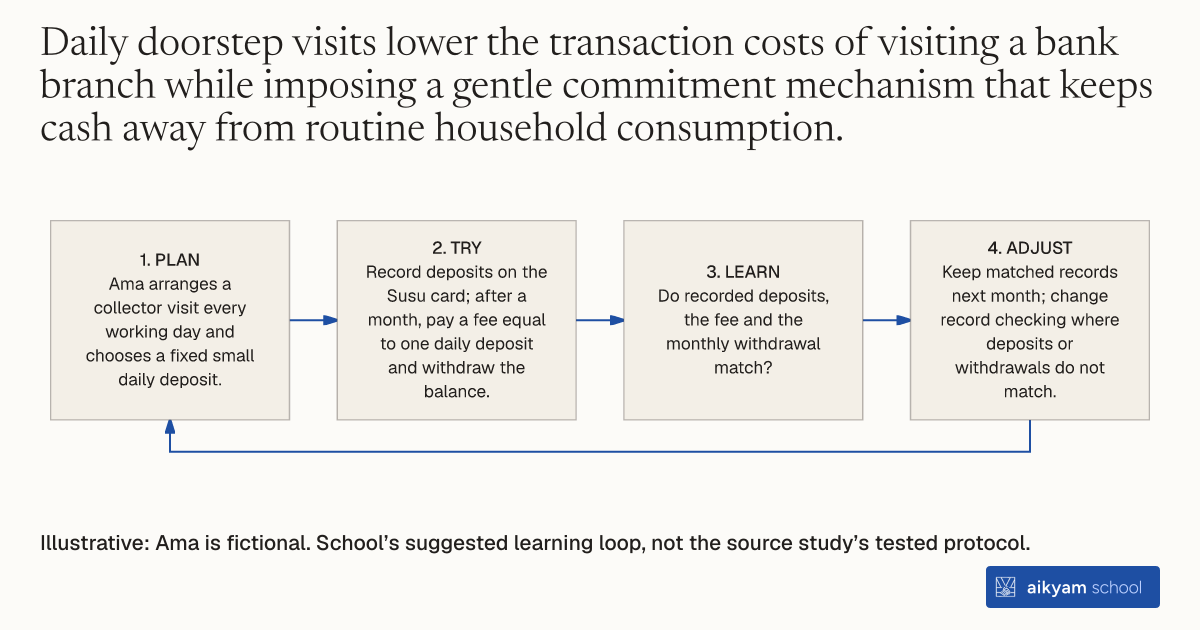
Try, learn and adjust
Check daily Susu deposits and monthly withdrawal
- Plan: Ama arranges a collector visit every working day and chooses a fixed small daily deposit.
- Try: Record deposits on the Susu card; after a month, pay a fee equal to one daily deposit and withdraw the balance.
- Learn: Do recorded deposits, the fee and the monthly withdrawal match?
- Adjust: Keep matched records next month; change record checking where deposits or withdrawals do not match.
Illustrative: Ama is fictional. School’s suggested learning loop, not the source study’s tested protocol.
See source →School’s suggested learning loop, not a tested source procedure. Observe daily records, the collection fee and the withdrawal; the study’s savings finding concerns combined grants and consulting.
How
When to use
Microenterprise owners often struggle to accumulate cash reserves for capital investments due to daily household spending pressures or lack of self-control mechanisms. Enrolling in daily doorstep micro-savings collection creates a structured, low-friction routine to build liquid business assets. This method serves small business owners who lack bank access or need discipline to save small daily earnings.
Set up a daily doorstep micro-savings accumulation routine with a mobile savings collector.
- Partner with a local Susu collector who visits the business shop every working day.
- Deposit a fixed small amount of cash from daily shop earnings with the collector during each visit.
- Record each daily deposit in a physical Susu card maintained by the owner and the collector.
- Allow the collector to accumulate deposits over a standard one-month cycle.
- Pay the collector a traditional fee equal to one daily deposit at the end of the month.
- Withdraw the accumulated monthly lump sum to purchase business inventory or equipment.
Example
Tailors in Accra, Ghana, used daily Susu collectors to build savings. Tailors who received combined capital grants and consulting increased their average monthly Susu savings from a baseline of 18.6 cedis to 28.38 cedis during the experiment.
About the study
Participants
150 urban microenterprise tailors and seamstresses in Accra, Ghana.
Study Design
Randomized Controlled Trial measuring total, bank, and Susu savings across 8 survey waves over two years.
Results
Combining capital grants and consulting increased monthly Susu savings by 16.63 cedis across pooled rounds (p < 0.10) and reached 28.38 cedis in Round 6 (p < 0.01) compared to a baseline mean of 18.6 cedis, whereas capital-only grants produced a non-statistically significant increase of 2.16 cedis.