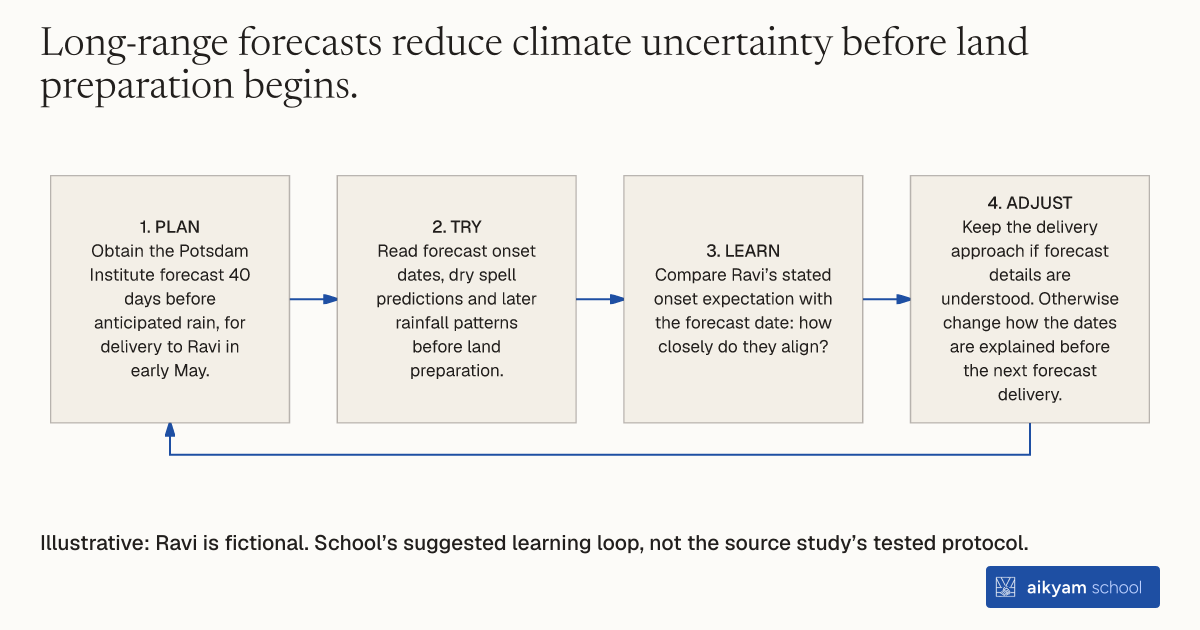
Try, learn and adjust
Check seasonal forecasts reach farmers before planting
- Plan: Obtain the Potsdam Institute forecast 40 days before anticipated rain, for delivery to Ravi in early May.
- Try: Read forecast onset dates, dry spell predictions and later rainfall patterns before land preparation.
- Learn: Compare Ravi’s stated onset expectation with the forecast date: how closely do they align?
- Adjust: Keep the delivery approach if forecast details are understood. Otherwise change how the dates are explained before the next forecast delivery.
Illustrative: Ravi is fictional. School’s suggested learning loop, not the source study’s tested protocol.
See source →School’s suggested learning loop, not a source-tested procedure. Observe stated monsoon expectations and the delivered forecast; understanding does not guarantee weather accuracy or welfare gains.
How
When to use
Smallholder farmers make critical land use and crop choices before monsoon rains arrive. Most rural producers rely on informal local advice rather than official weather predictions. Delivering accurate 40-day advance seasonal forecasts provides households with reliable weather expectations to guide planting decisions.
Deliver long-range seasonal weather forecasts directly to agricultural households weeks before seasonal planting.
- Obtain Potsdam Institute seasonal monsoon forecasts 40 days in advance of anticipated rain.
- Visit rural farming households during early May prior to land preparation.
- Read the specific forecast dates and dry spell predictions directly to each household.
- Provide details specifying predicted start dates and subsequent rainfall patterns.
Why it works
Accurate advance warnings allow farmers to align crop choices and land commitments with expected rainfall.
Example
Researchers provided seasonal monsoon forecasts to 497 households across 100 villages in Telangana, India. The forecast accurately predicted monsoon onset between June 11th and June 19th, followed by a dry spell from June 20th to June 29th and continuous rain after June 29th.
About the study
Participants
497 farming households in 100 forecast villages (out of 1,240 households in 250 total villages) in Telangana, India.
Study Design
Randomized Controlled Trial (RCT) assigning villages to receive Potsdam Institute seasonal forecasts, index insurance, or comparison status.
Results
Forecast delivery caused receiving farmers to hold monsoon beliefs 27 percent closer to the predicted onset date compared to comparison households.