Research steps
Record monsoon expectations before forecasts
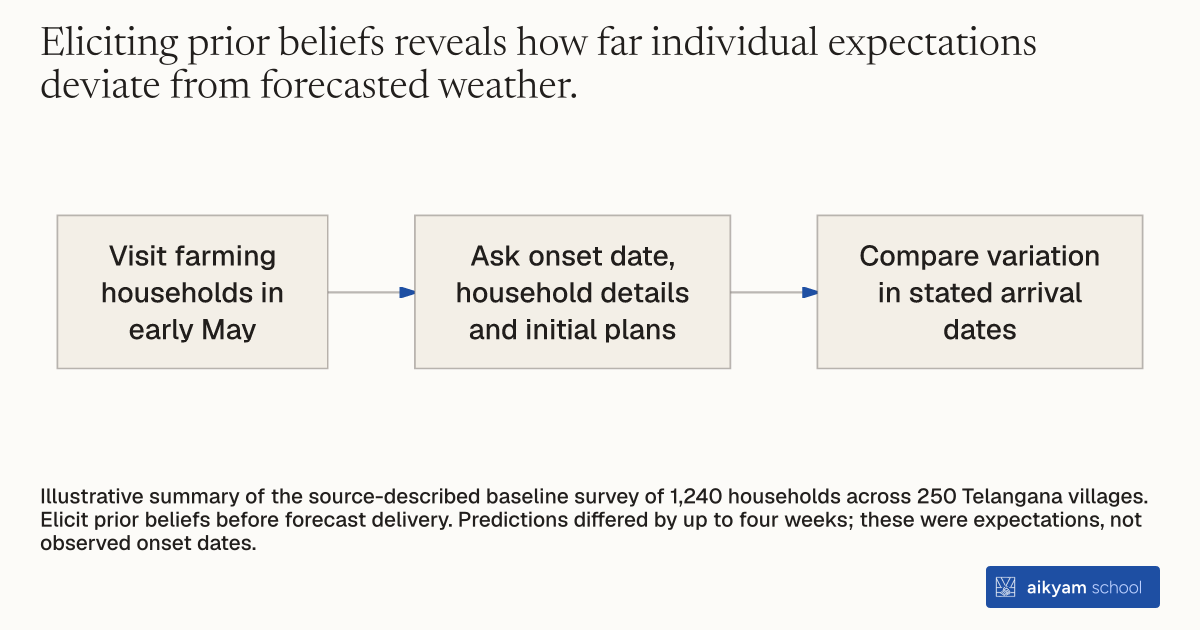
- Visit farming households in early May
- Ask onset date, household details and initial plans
- Compare variation in stated arrival dates
Illustrative summary of the source-described baseline survey of 1,240 households across 250 Telangana villages. Elicit prior beliefs before forecast delivery. Predictions differed by up to four weeks; these were expectations, not observed onset dates.
See source →How
When to use
Agricultural households make production decisions based on expectations about monsoon onset timing. Individual expectations vary widely, causing many farmers to make investment choices poorly suited to actual weather. Surveying farmers before seasonal forecasts arrive diagnoses baseline belief distortions across the target population.
Measure individual expectations of monsoon arrival before releasing seasonal weather forecasts.
- Visit agricultural households in early May prior to monsoon onset.
- Elicit each farmer's expected arrival date for the summer monsoon.
- Administer a short survey recording household characteristics and initial agricultural plans.
- Record variations across households to pinpoint individual deviations from average arrival dates.
Why it works
This diagnostic step shows whether upcoming forecasts imply better or worse conditions for each farmer.
Example
Researchers surveyed farmers across 250 villages in Telangana, India, in early May. The survey revealed that individual predictions varied considerably, with some farmers expecting the monsoon to arrive up to four weeks earlier than others.
About the study
Participants
1,240 farming households across 250 villages in Telangana, India.
Study Design
Baseline survey enumeration in early May during a randomized evaluation across forecast, insurance, and comparison village arms.
Results
Individual predictions differed by up to four weeks between farmers, even though the average prior belief matched the realized onset date.