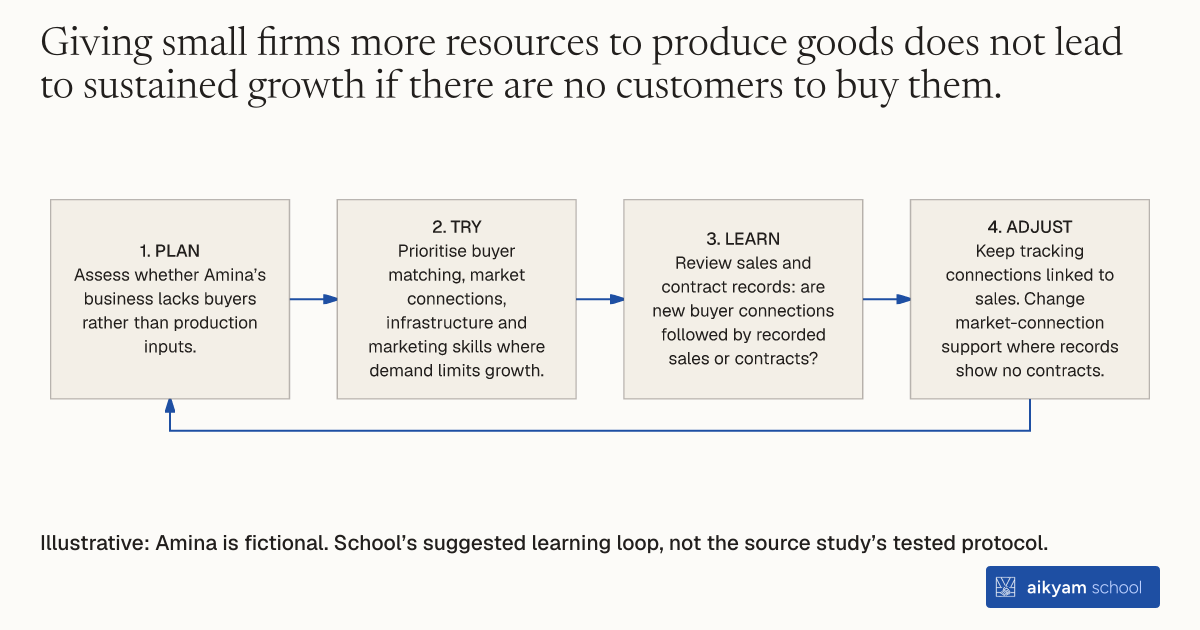
Try, learn and adjust
Check buyer connections and contracts
- Plan: Assess whether Amina’s business lacks buyers rather than production inputs.
- Try: Prioritise buyer matching, market connections, infrastructure and marketing skills where demand limits growth.
- Learn: Review sales and contract records: are new buyer connections followed by recorded sales or contracts?
- Adjust: Keep tracking connections linked to sales. Change market-connection support where records show no contracts.
Illustrative: Amina is fictional. School’s suggested learning loop, not the source study’s tested protocol.
See source →School’s suggested, untested loop. Observe sales and contract acquisition; this does not prove sustained employment or revenue effects.
How
When to use
Small firms in low- and middle-income countries often struggle to expand despite receiving supply-side resources like microcredit and skills training. Traditional supply-side programs yield modest growth because firms fundamentally lack accessible buyers. Prioritizing demand-side market access interventions helps development organizations unlock business expansion and job creation.
Prioritize demand-side market access interventions over traditional supply-side inputs when designing private sector development strategies.
- Development agencies evaluate target firm sectors to identify whether growth is limited by a lack of buyers rather than production inputs.
- Program designers reallocate funding from standalone microcredit and general managerial training toward buyer-matching and market connection programs.
- Facilitators establish mechanisms that connect small firms to large domestic buyers, government procurement systems, and international exporters.
- Policymakers invest in market infrastructure and marketing skills training to reduce search and information frictions between buyers and sellers.
- Program managers monitor firm sales and contract acquisition to ensure market access translates into sustained revenue and employment growth.
Why it works
Addressing demand-side constraints directly connects businesses to buyers, enabling firms to increase sales, improve quality, and expand employment.
Example
A synthesis of 15 randomized evaluations and 4 quasi-experimental studies across low- and middle-income countries showed that market access interventions increased firm revenues, profits, and product quality across various industries, whereas traditional supply-side inputs had only modest effects.