Research procedure
Test flyer framing variations
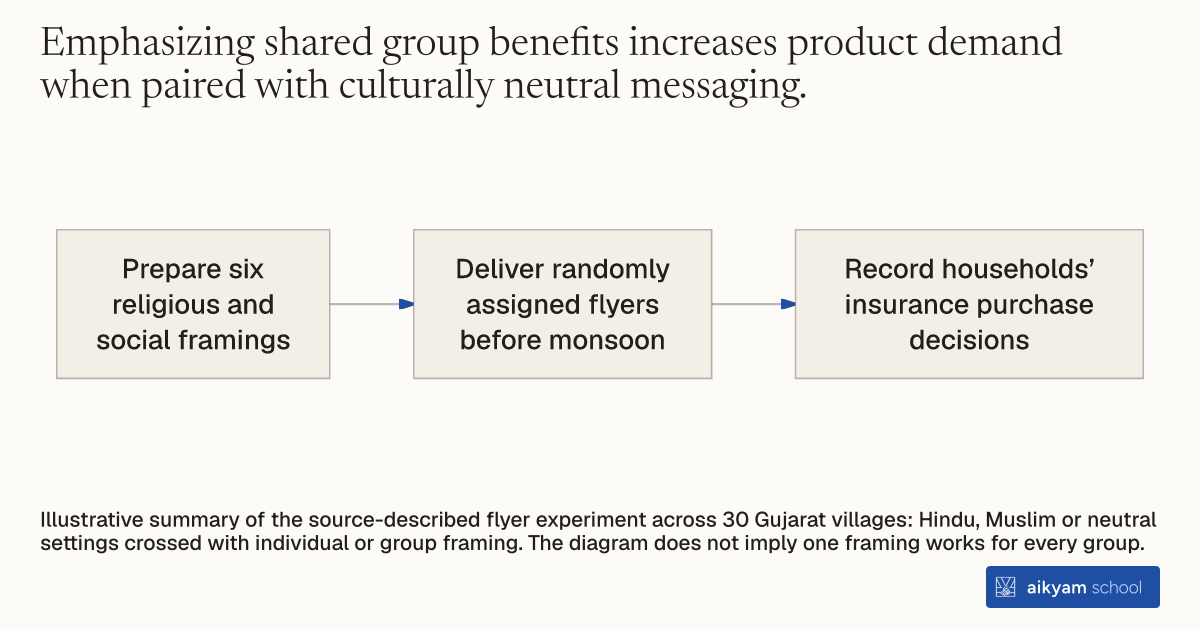
- Prepare six religious and social framings
- Deliver randomly assigned flyers before monsoon
- Record households’ insurance purchase decisions
Illustrative summary of the source-described flyer experiment across 30 Gujarat villages: Hindu, Muslim or neutral settings crossed with individual or group framing. The diagram does not imply one framing works for every group.
See source →How
When to use
Rural households often ignore standard promotional materials for unfamiliar financial products. Abstract insurance descriptions fail to motivate smallholder farmers to purchase weather coverage. Delivering direct promotional flyers that combine social framing and cultural cues tests how messaging affects policy take-up.
Distribute promotional flyers testing variations in religious context and social framing to target rural households.
- NGO staff design promotional flyers highlighting insurance benefits before the upcoming monsoon season.
- Marketers create six flyer variations combining religious settings (Hindu, Muslim, or neutral) with social mentalities (individual or group).
- Field teams deliver assigned flyer variations directly to target households in rural villages.
- Household members read the promotional flyers and evaluate rainfall insurance policy options.
- Families decide whether to purchase insurance policies during the seasonal marketing campaign.
Why it works
However, social cues that highlight out-group identities create resistance and reduce household purchases.
Example
In Gujarat, SEWA distributed six flyer variations combining religious and social framing to households across 30 rural villages in advance of the 2007 monsoon season.
About the study
Participants
Rural households across 30 villages in Gujarat, India (where roughly half the sample belonged to a scheduled caste or tribe).
Study Design
Randomized controlled trial testing household insurance adoption across six randomly assigned promotional flyer variations combining social framing and religious cues.
Results
The average take-up rate among flyer recipients was 23.8 percent, and the flyer emphasizing group mentality increased take-up when combined with a neutral religious message but decreased take-up when combined with a Muslim religious setting.