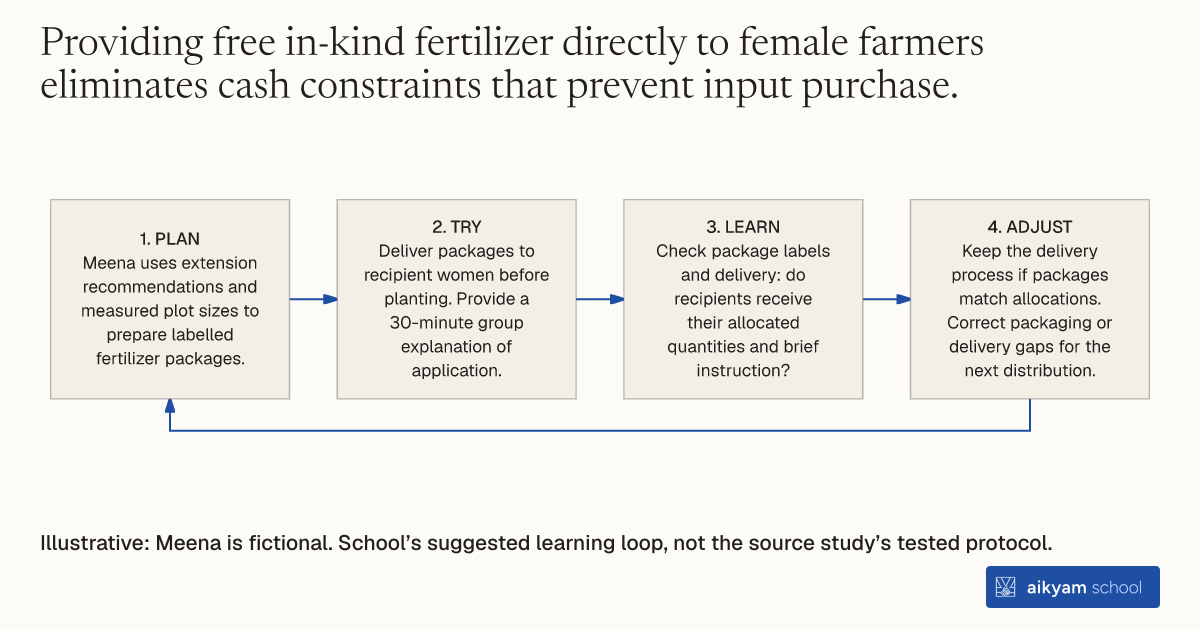
Try, learn and adjust
Check delivery of labelled input grants
- Plan: Meena uses extension recommendations and measured plot sizes to prepare labelled fertilizer packages.
- Try: Deliver packages to recipient women before planting. Provide a 30-minute group explanation of application.
- Learn: Check package labels and delivery: do recipients receive their allocated quantities and brief instruction?
- Adjust: Keep the delivery process if packages match allocations. Correct packaging or delivery gaps for the next distribution.
Illustrative: Meena is fictional. School’s suggested learning loop, not the source study’s tested protocol.
See source →School’s suggested learning loop checks delivery and instruction, separately from the study’s unmonitored fertilizer grants. It does not add ongoing farm monitoring.
How
When to use
Agricultural development programs often struggle to increase technology adoption among smallholder female farmers facing severe cash and credit constraints. Delivering direct in-kind input grants alongside basic technical instruction overcomes immediate liquidity barriers to technology adoption. This method is designed for program officers and researchers distributing agricultural inputs to targeted female producers.
Deliver targeted in-kind fertilizer grants and brief practical instruction to smallholder female producers during the pre-planting season.
- Research local extension recommendations to select appropriate fertilizer compositions and recommended per-hectare quantities.
- Calculate target input quantities for each farmer based on individual plot size measurements.
- Package, bag, and label specific fertilizer quantities for each participant prior to field delivery.
- Send distribution teams to target villages in late May before planting begins to deliver labeled fertilizer packages directly to recipient women.
- Provide a short 30-minute group instruction session explaining proper fertilizer application techniques without conducting ongoing monitoring or training.
Why it works
Brief practical instructions ensure recipients understand application basics without requiring high ongoing supervisory costs.
Example
In late May 2010, research teams in Bougouni district, southern Mali, bagged and labeled fertilizer for 258 female rice farmers across 23 villages, distributing full grants averaging 65.71 kg (308.20 kg/ha) or half grants averaging 32.09 kg (156.04 kg/ha) alongside a 30-minute explanation.
About the study
Participants
383 female rice farmers across 23 villages in Bougouni district, southern Mali (258 treatment, 125 control).
Study Design
Randomized controlled trial evaluating unmonitored in-kind fertilizer grants (full recommended vs. half recommended vs. control) accompanied by a 30-minute training session.
Results
In-kind grants increased fertilizer usage likelihood by 64 percentage points (p < 0.01) over a 32 percent control baseline, increasing fertilizer quantity used by 21.28 kg (SE = 4.10, p < 0.01) in half treatment and 32.91 kg (SE = 4.05, p < 0.01) in full treatment.