Research procedure
Build a female farmer sample
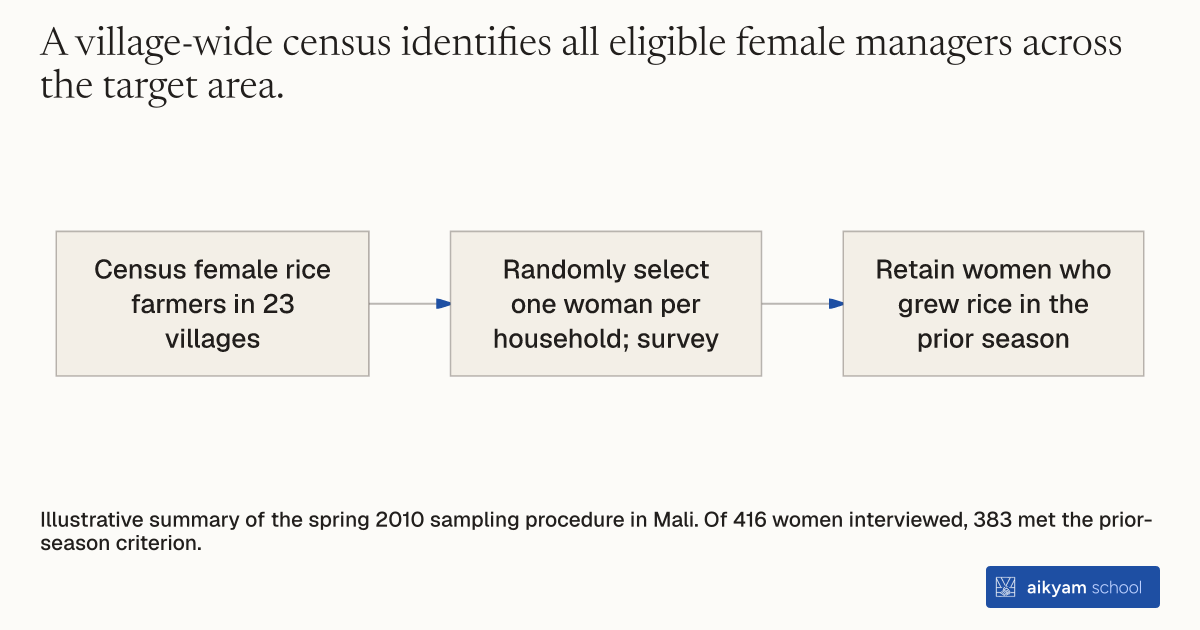
- Census female rice farmers in 23 villages
- Randomly select one woman per household; survey
- Retain women who grew rice in the prior season
Illustrative summary of the spring 2010 sampling procedure in Mali. Of 416 women interviewed, 383 met the prior-season criterion.
See source →How
When to use
Use this method when selecting a representative target population of smallholder producers in rural areas where administrative registers do not exist. It solves the problem of sampling bias and unverified target population status. It is designed for researchers and project managers identifying female agricultural managers within rural communities.
Execute a village census and random household sampling to build a verified sample frame of active female farmers.
- Send enumerators to selected rural villages during the pre-planting spring season.
- Conduct a full census of all women farming the target crop across every selected village in the district.
- Select one female farmer at random from each household list generated during the census.
- Administer a baseline survey to each selected woman collecting economic, asset, and agricultural data.
- Retain respondents who cultivated the target crop during the prior agricultural season to form the final sample frame.
Why it works
Randomly selecting one woman per household eliminates selection bias and creates an accurate sample frame for agricultural evaluations.
Example
In spring 2010, research teams visited 23 villages in Bougouni district, southern Mali. They conducted a census of female rice farmers, interviewed 416 respondents, and retained 383 women who cultivated rice in the prior season.
About the study
Participants
383 female rice farmers (378 analyzed at endline) across 23 villages in Bougouni district, southern Mali.
Study Design
Randomized controlled trial sampling using a village-level census followed by random selection of one woman per household and a baseline survey.
Results
Research teams interviewed 416 women, identifying 383 who cultivated rice in the prior season to establish the baseline sample frame across 23 villages with an average plot size of 0.22 hectares.