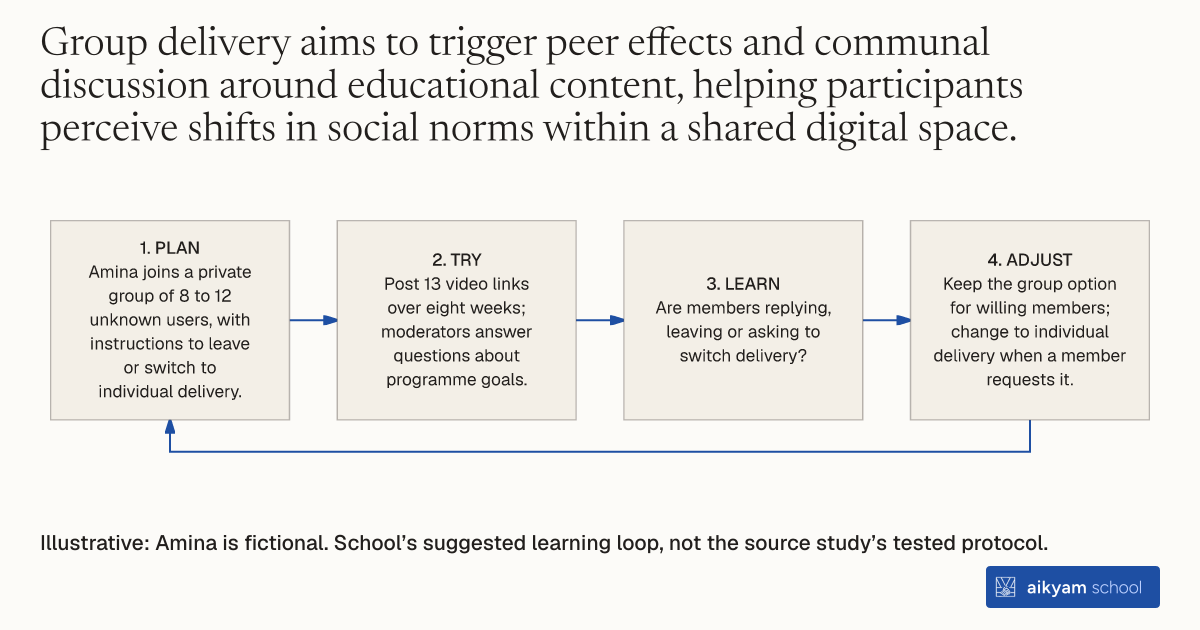
Try, learn and adjust
Check WhatsApp group delivery and choice
- Plan: Amina joins a private group of 8 to 12 unknown users, with instructions to leave or switch to individual delivery.
- Try: Post 13 video links over eight weeks; moderators answer questions about programme goals.
- Learn: Are members replying, leaving or asking to switch delivery?
- Adjust: Keep the group option for willing members; change to individual delivery when a member requests it.
Illustrative: Amina is fictional. School’s suggested learning loop, not the source study’s tested protocol.
See source →School’s suggested learning loop, not a tested source procedure. Observe delivery choice and group replies; low conversation does not show that videos were not watched.
How
When to use
When organizations want to leverage group dynamics or peer effects to deliver educational content remotely, distributing materials in messaging groups can connect participants. Small online group channels aim to replicate offline communal viewing and peer discussions among participants without requiring physical gatherings during mobility restrictions. This method serves individuals who can benefit from shared educational resources delivered directly to their mobile devices.
Distribute educational video links within small, peer-based WhatsApp group chats over a scheduled program period.
- Assign opted-in participants to private WhatsApp group chats consisting of 8 to 12 unknown users.
- Provide explicit instructions on how participants can leave the group or switch to individual delivery if preferred.
- Post links directing members to hosted educational videos on a fixed schedule across an 8-week campaign.
- Station designated moderators in every group chat to answer basic inquiries about program goals.
- Monitor group conversation dynamics to maintain a respectful space without engaging in heavy content facilitation.
Why it works
Delivering links in messaging groups maintains direct mobile engagement while providing a communal framework.
Example
In Egypt, researchers assigned 1,879 female Facebook users to 200 small WhatsApp groups of 8 to 12 participants and sent 13 edutainment video links over 8 weeks, increasing knowledge of support resources by 0.299 standard deviations and recent resource use by 0.100 standard deviations.
About the study
Participants
1,879 female Facebook users in Egypt assigned to WhatsApp group chats out of 5,618 total study participants.
Study Design
Randomized controlled trial assigning participants to WhatsApp group chats of 8 to 12 members receiving 13 video links over eight weeks, compared against individual WhatsApp messaging, Facebook messages, TV reminders, and a control group.
Results
Group chat distribution increased video consumption recall by 0.935 standard deviations, increased resource knowledge by 0.299 standard deviations, increased recent resource use by 0.100 standard deviations, but showed very low aggregate group conversation (112 out of 200 groups had no member replies).