Try, learn and adjust
Check hub users can complete digital tasks
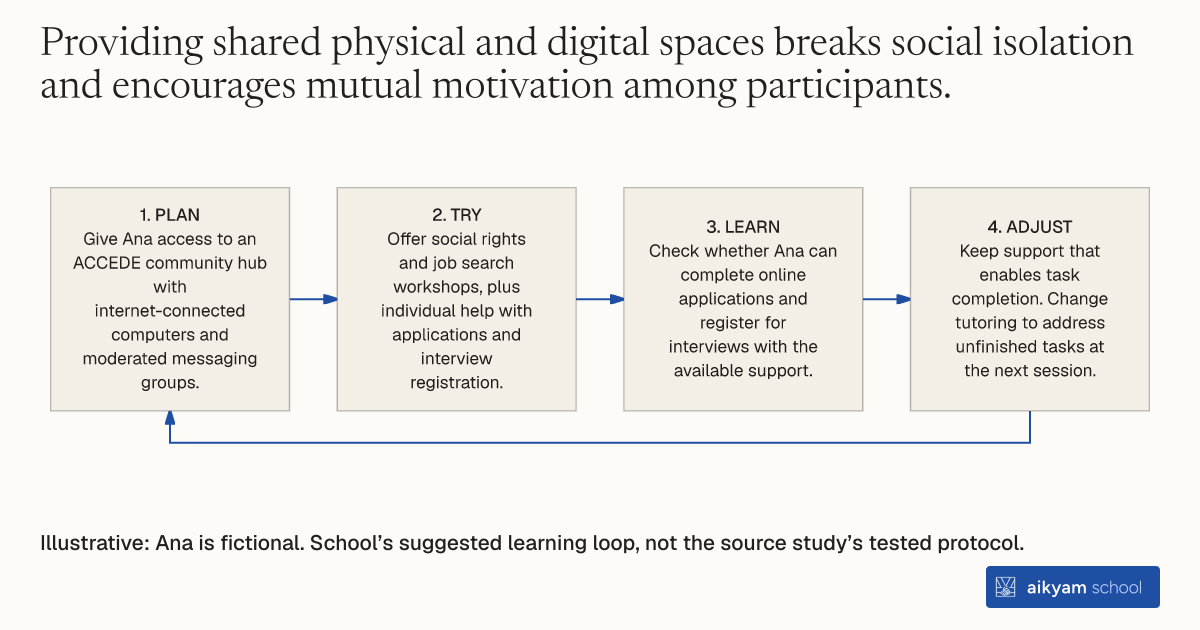
- Plan: Give Ana access to an ACCEDE community hub with internet-connected computers and moderated messaging groups.
- Try: Offer social rights and job search workshops, plus individual help with applications and interview registration.
- Learn: Check whether Ana can complete online applications and register for interviews with the available support.
- Adjust: Keep support that enables task completion. Change tutoring to address unfinished tasks at the next session.
Illustrative: Ana is fictional. School’s suggested learning loop, not the source study’s tested protocol.
See source →School’s suggested, untested loop: observe hub access, application completion and interview registration. The source evaluates a combined programme.
How
When to use
Social welfare beneficiaries often suffer from social isolation and lack physical internet access needed to navigate administrative rights or seek employment. Traditional individual casework fails to build community support or mutual assistance among recipients. This method establishes physical communal hubs and moderated digital communication groups to foster social inclusion and active job searching.
Establish open-access communal hub spaces and peer networks for social protection beneficiaries.
- Set up dedicated physical hub spaces equipped with internet-connected computers in local community or parish locations.
- Program staff create moderated mobile messaging groups to maintain continuous peer communication and information sharing.
- Facilitators lead interactive workshops on navigating administrative social rights and conducting online job searches.
- Staff offer individual digital tutoring to help participants complete online applications and register for job interviews.
Why it works
Peer interaction combined with accessible digital tools simplifies administrative navigation and builds job application confidence.
Example
Cáritas implemented the ACCEDE program across 96 parish locations in 18 Spanish municipalities for social protection recipients. Staff established community hubs with digital access points, WhatsApp communication groups, and social rights workshops over thirteen months. The intervention significantly increased job applications, interview participation, vocational training take-up, and household income.
About the study
Participants
2,625 social protection recipients across 96 parish locations in 18 Spanish municipalities.
Study Design
Cluster Randomised Controlled Trial (RCT) evaluating a 13-month communal hub and digital access intervention implemented by Cáritas.
Results
The intervention increased participants' job applications, participation in recruitment interviews, and take-up of professional training, while delivering a large positive impact on household income and community group participation.