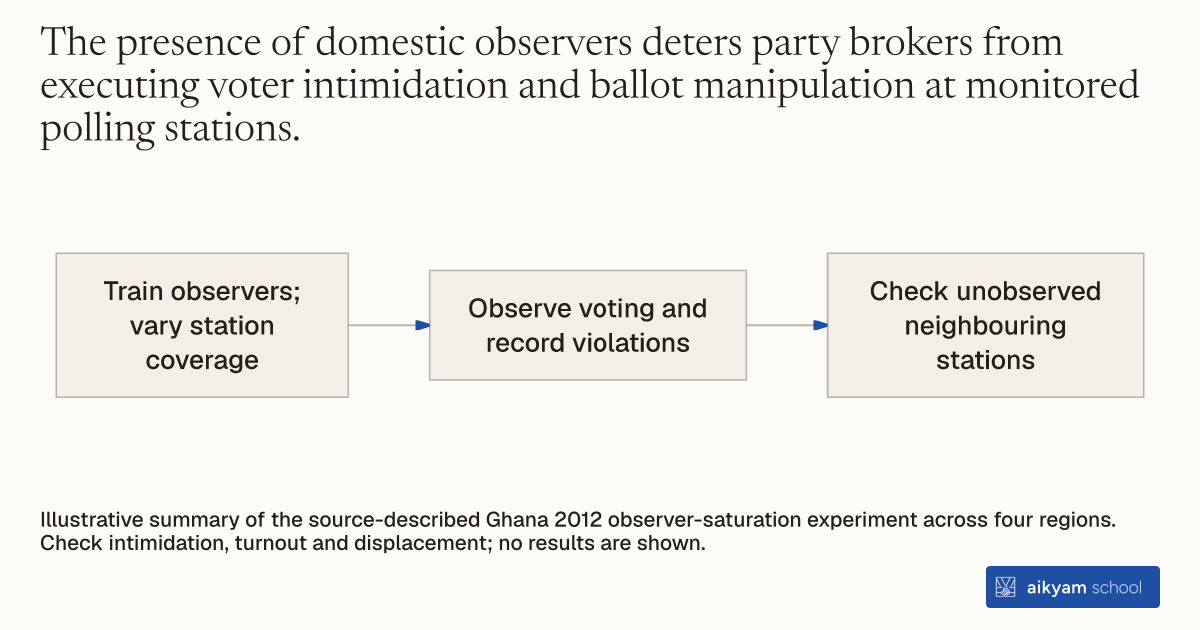
Research procedure
Observe stations and nearby displacement
- Train observers; vary station coverage
- Observe voting and record violations
- Check unobserved neighbouring stations
Illustrative summary of the source-described Ghana 2012 observer-saturation experiment across four regions. Check intimidation, turnout and displacement; no results are shown.
See source →How
When to use
Political parties use voter intimidation and electoral fraud at polling stations to manipulate election results. Election monitoring networks face difficulty detecting malpractice across widespread polling locations. This method helps domestic observation coalitions deploy observers across varying saturation levels to protect voting integrity and evaluate displacement effects.
Deploy trained domestic election observers across varying saturation levels of polling stations within targeted electoral constituencies on election day.
- Partner with a domestic election observation coalition to recruit and train local observers.
- Select target regions and vary the proportion of polling stations assigned an observer within each constituency.
- Station observers at assigned polling places throughout election day.
- Record occurrences of voter intimidation, procedural violations, and total vote turnout.
- Monitor unobserved neighboring polling stations to identify whether parties displace fraud or violence to unmonitored sites.
Why it works
In competitive constituencies where party oversight prevents easy fraud substitution, parties shift voter intimidation and violence to unobserved polling stations.
Example
During the 2012 elections in Ghana, researchers partnered with the Coalition of Domestic Election Observers to assign observers to polling stations across four regions, which reduced intimidation by 7 percentage points and reduced voter turnout by 4.5 percentage points.
About the study
Participants
Polling stations across four of Ghana's ten regions during the 2012 elections.
Study Design
Randomized field experiment varying the saturation proportion of observers assigned across polling stations within constituencies.
Results
Reduced the probability of intimidation during voting by 7 percentage points from a base of 12 percent, reduced voter turnout by 4.5 percentage points from a base of 86 percent, displaced fraud to unobserved stations in single-party-dominant constituencies, and displaced violence and intimidation to unobserved stations in competitive constituencies.