Try, learn and adjust
Check the anti-violence campaign uses its full mix
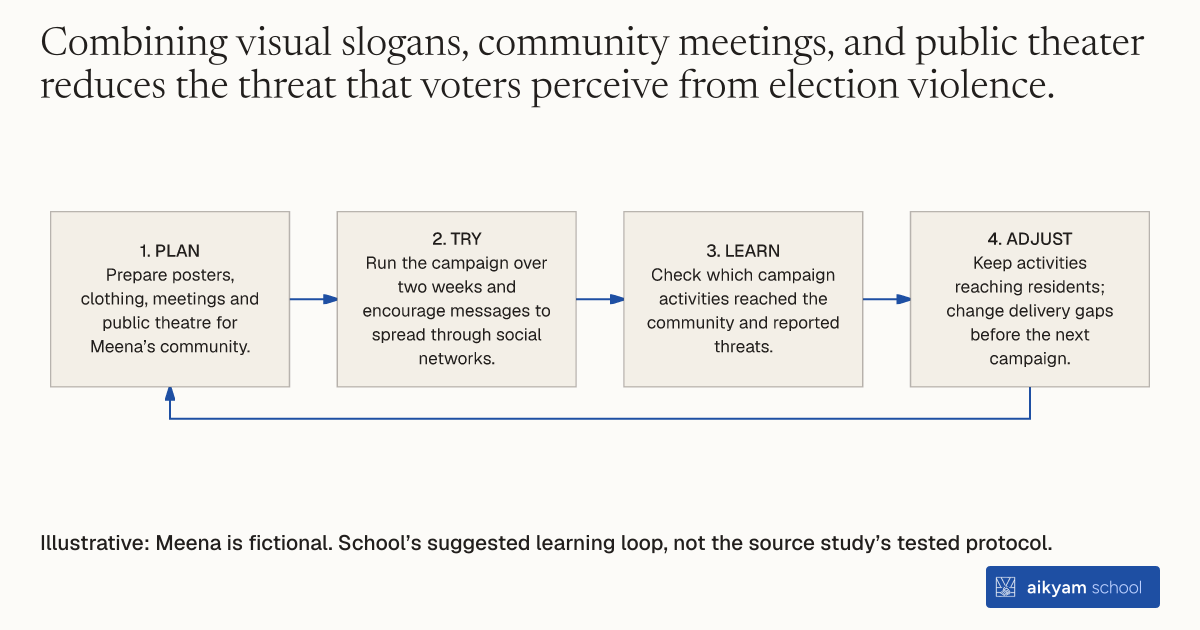
- Plan: Prepare posters, clothing, meetings and public theatre for Meena’s community.
- Try: Run the campaign over two weeks and encourage messages to spread through social networks.
- Learn: Check which campaign activities reached the community and reported threats.
- Adjust: Keep activities reaching residents; change delivery gaps before the next campaign.
Illustrative: Meena is fictional. School’s suggested learning loop, not the source study’s tested protocol.
See source →Campaign coverage and reports of threats or intimidation; no assumed reduction. School’s suggested learning loop, not a source-tested cycle.
How
When to use
Political candidates and armed supporters use violence and physical threats to intimidate voters during elections. Citizens perceive high personal danger and refrain from turning out at polling places. This method helps civil society organizations reduce the threat of voter intimidation and increase voter participation.
Execute a multi-media anti-violence public campaign combining posters, branded clothing, town meetings, and public theater to reduce perceived threats of violence.
- Produce campaign posters and clothing displaying clear anti-violence slogans prior to elections.
- Schedule and host town meetings in target electoral areas to discuss election nonviolence.
- Organize public theater performances in local communities that portray peaceful voting and challenge the viability of violence.
- Distribute branded clothing and posters to community members across target areas during a two-week period.
- Encourage campaign messaging to diffuse naturally through local social networks and family ties.
Why it works
Lowering perceived vulnerability weakens the effectiveness of voter intimidation tactics and encourages citizens to turn out to vote.
Example
During the violent 2007 elections in Nigeria, ActionAid International Nigeria ran a two-week campaign using posters, clothing, town meetings, and public theater, which reduced actual physical violence by 47 percentage points and increased voter turnout.
About the study
Participants
Registered voters and local communities across targeted areas in Nigeria during the 2007 elections.
Study Design
Randomized field experiment evaluating a two-week anti-violence voter education campaign against unexposed control communities, with reports collected from independent local journalists.
Results
Reduced the likelihood of physical violence occurring by 47 percentage points from a base of 50 percent, decreased citizens' perceptions of violence, increased voter turnout, and decreased the vote share of the opposition presidential candidate associated with violence.