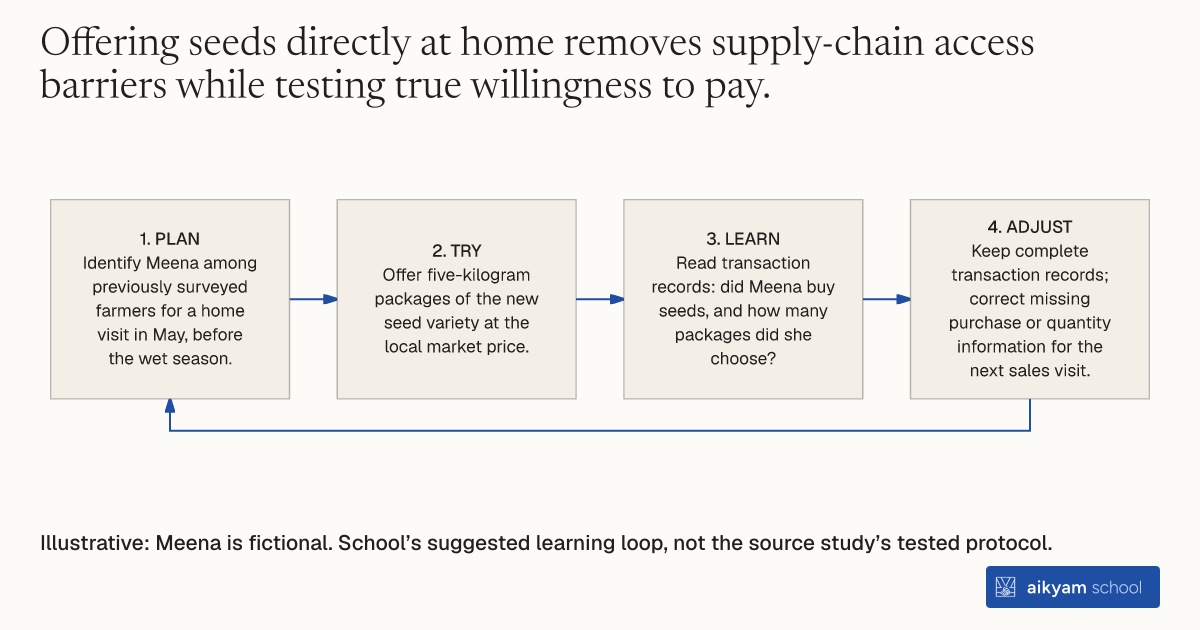
Try, learn and adjust
Check seed sales and chosen quantities
- Plan: Identify Meena among previously surveyed farmers for a home visit in May, before the wet season.
- Try: Offer five-kilogram packages of the new seed variety at the local market price.
- Learn: Read transaction records: did Meena buy seeds, and how many packages did she choose?
- Adjust: Keep complete transaction records; correct missing purchase or quantity information for the next sales visit.
Illustrative: Meena is fictional. School’s suggested learning loop, not the source study’s tested protocol.
See source →School’s suggested learning loop, not a tested protocol. Observe recorded purchase decisions and package quantities, not crop outcomes.
How
When to use
Smallholder farmers in remote rural villages often face high transaction costs traveling to commercial markets to buy new seed varieties. Program staff need an accurate, direct way to measure actual adoption demand following community learning activities. This method brings input packages directly to farmers' doorsteps and offers them for purchase at prevailing market prices.
Visit surveyed farmers at home immediately prior to the planting season to offer new crop seeds at market price.
- NGO staff identify target farmers who previously participated in evaluation surveys.
- NGO staff visit each farmer at home in May, immediately prior to the wet growing season.
- NGO staff carry five-kilogram seed packages of the new crop variety.
- NGO staff offer the seed packages for direct purchase at a price matching the local market value.
- NGO staff record individual purchase transactions and package quantities chosen by each household.
Why it works
Selling at market rates allows researchers to measure genuine economic demand rather than artificially inflated take-up driven by subsidies.
Example
In May 2015, NGO staff visited surveyed rice farmers at their homes across 100 villages in Odisha, India, immediately before the wet planting season. Staff offered flood-tolerant Swarna-Sub1 rice seeds in five-kilogram packages at prevailing market prices. Seed adoption reached 41.7 percent in villages that had hosted farmer field days, compared to 29.7 percent in comparison villages.
About the study
Participants
100 villages in Odisha, India; surveyed rice farmers where two-thirds lived below the US\$2.15/day poverty line.
Study Design
Randomized Controlled Trial measuring direct seed purchases during May 2015 home visits following randomized exposure to November 2014 farmer field days.
Results
Door-to-door market-priced sales revealed a 41 percent increase in seed adoption in field day villages (41.7 percent adoption) compared to comparison villages (29.7 percent adoption), driven largely by a 59 percent increase in single 5-kilogram package purchases.