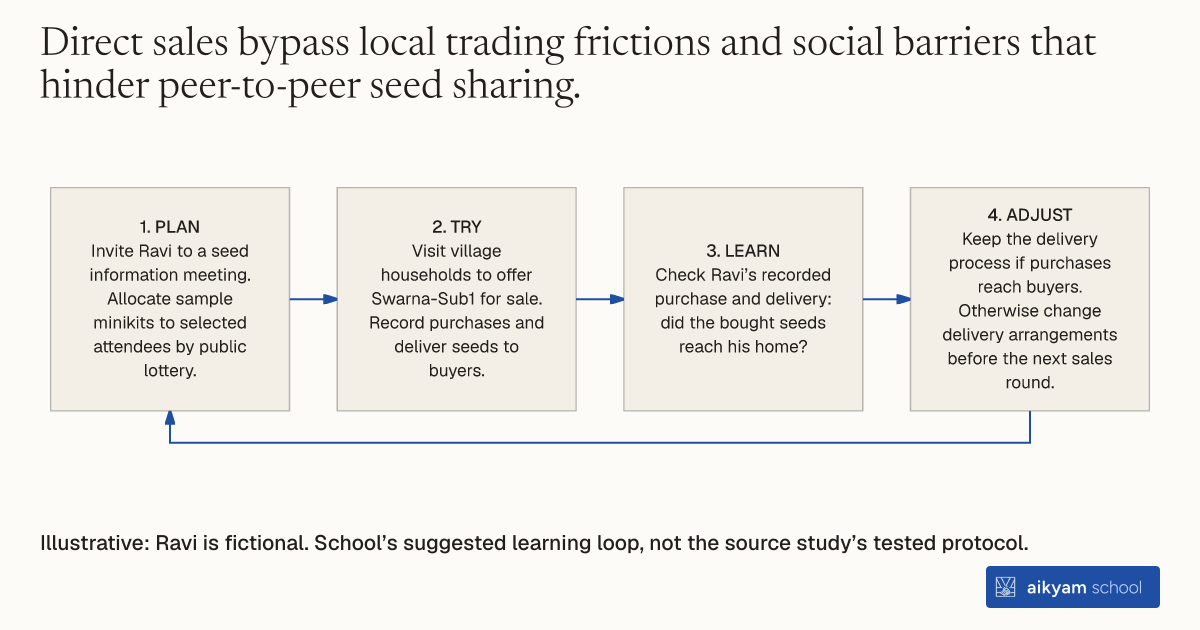
Try, learn and adjust
Check household seed sales and delivery
- Plan: Invite Ravi to a seed information meeting. Allocate sample minikits to selected attendees by public lottery.
- Try: Visit village households to offer Swarna-Sub1 for sale. Record purchases and deliver seeds to buyers.
- Learn: Check Ravi’s recorded purchase and delivery: did the bought seeds reach his home?
- Adjust: Keep the delivery process if purchases reach buyers. Otherwise change delivery arrangements before the next sales round.
Illustrative: Ravi is fictional. School’s suggested learning loop, not the source study’s tested protocol.
See source →School’s suggested learning loop: observe purchases and delivery; do not assume the study’s adoption result for Ravi.
How
When to use
Smallholder farmers often fail to acquire new seed varieties because peer-to-peer trading faces local market and social frictions. Relying solely on informal farmer-to-farmer exchanges leaves seed adoption rates low. Direct door-to-door sales ensure that interested farmers can purchase new seeds directly at their homes.
Deliver and sell new seed packages directly to households to overcome local trading frictions.
- Program officers invite village farmers to attend an informational meeting about the benefits of Swarna-Sub1 seeds.
- Field staff assign sample minikits to selected meeting attendees via a public lottery.
- Sales agents visit village households directly at their homes to offer Swarna-Sub1 seeds for purchase.
- Agents record seed purchases and deliver the seed packages directly to buying farmers.
Why it works
Reaching farmers directly at home ensures immediate access for everyone interested in buying the technology.
Example
In 82 villages in Bhadrak district, Odisha, researchers evaluated direct door-to-door sales following village informational meetings. One year after introduction, seed adoption reached 40 percent under direct door-to-door sales compared to 7 percent under informal peer trading.
About the study
Participants
82 villages in Bhadrak district, Odisha, India.
Study Design
Randomized evaluation comparing seed adoption rates between villages relying on peer-to-peer seed trading and villages receiving direct door-to-door sales following village informational meetings.
Results
One year after introducing the seeds, seed adoption reached 40 percent under direct door-to-door sales compared to 7 percent under informal peer sharing (over a five-fold increase).