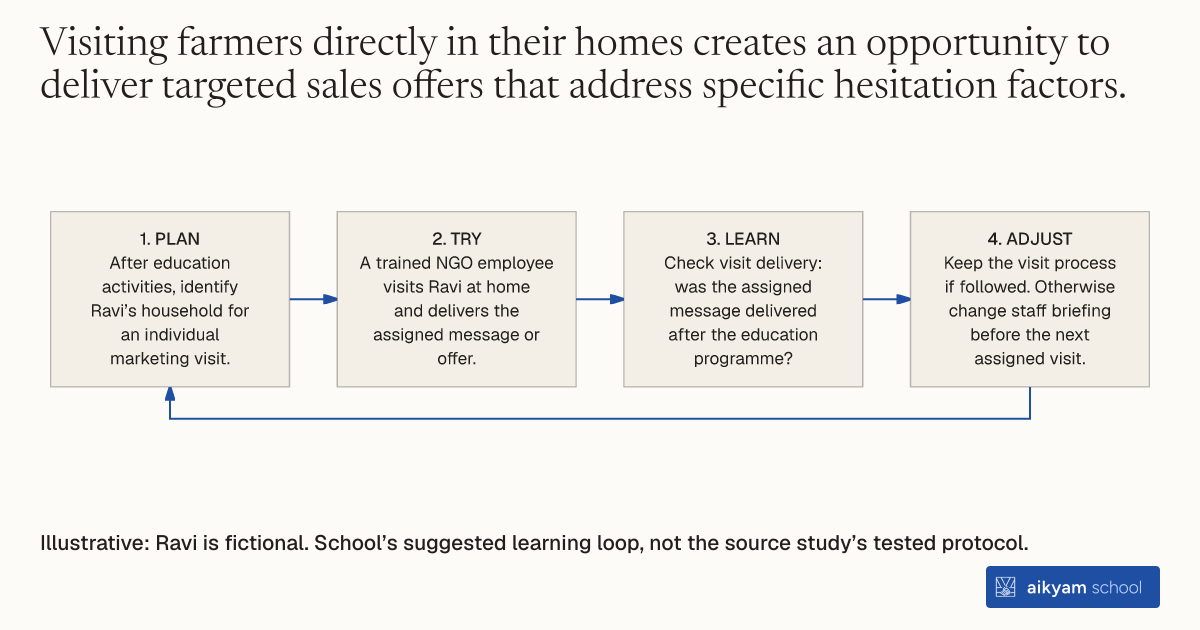
Try, learn and adjust
Check assigned messages reach households
- Plan: After education activities, identify Ravi’s household for an individual marketing visit.
- Try: A trained NGO employee visits Ravi at home and delivers the assigned message or offer.
- Learn: Check visit delivery: was the assigned message delivered after the education programme?
- Adjust: Keep the visit process if followed. Otherwise change staff briefing before the next assigned visit.
Illustrative: Ravi is fictional. School’s suggested learning loop, not the source study’s tested protocol.
See source →School’s suggested, untested learning loop. Observe visit timing and assigned message delivery. The study randomly selected 282 households from treatment and comparison groups.
How
When to use
Smallholder farmers in rural communities often hesitate to purchase unfamiliar microinsurance products after initial educational sessions. Sending trained field employees to visit households directly provides a tailored channel to deliver promotional messages and answer remaining questions. This method helps agricultural development organizations engage farmers in home settings after completing broad community education.
Conduct individual follow-up marketing visits to rural farming households using trained partner employees.
- Identify target farming households in project villages after finishing initial educational activities.
- Select 282 farming households across treatment and comparison groups to receive individual visits.
- Assign trained NGO employees to visit selected farmers individually at their homes.
- Deliver specific sales messages or promotional offers during the visit to address adoption barriers.
Why it works
Personal interaction reinforces product details and encourages immediate purchasing decisions.
Example
In Gujarat, India, Development Support Center staff visited 282 cotton and groundnut farmers individually in their homes after a financial education program, delivering assigned promotional messages that tested sales impacts.
About the study
Participants
282 farming households selected from a study sample of 600 landowning farmers in Gujarat, India.
Study Design
Randomized evaluation where NGO workers conducted individual marketing visits delivering distinct promotional messages after financial education programs ended.
Results
Half of the households receiving a follow-up visit had also received an invitation to the education program, allowing researchers to measure demand impacts across marketing strategies.