Research comparison
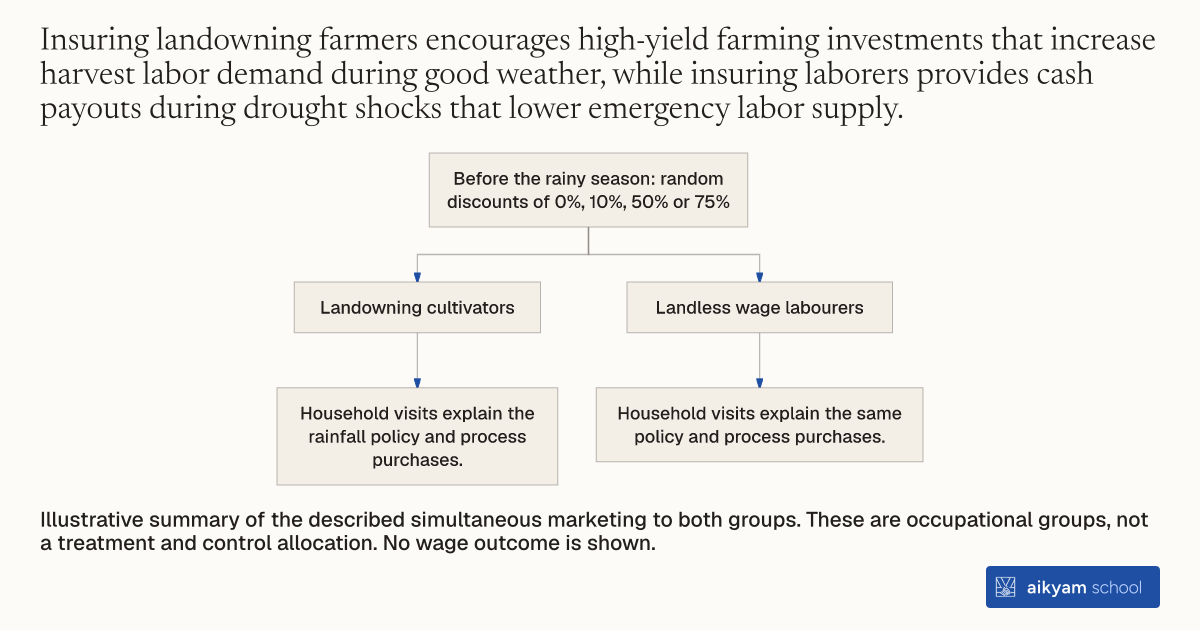
Offer insurance to both occupational groups
Before the rainy season: random discounts of 0%, 10%, 50% or 75%
- Landowning cultivators
- Household visits explain the rainfall policy and process purchases.
- Landless wage labourers
- Household visits explain the same policy and process purchases.
Illustrative summary of the described simultaneous marketing to both groups. These are occupational groups, not a treatment and control allocation. No wage outcome is shown.
See source →How
When to use
Microinsurance programs in developing agricultural economies typically target landowning farmers while excluding landless wage laborers. Restricting insurance to landowners induces risk-taking that amplifies local wage volatility for uninsured workers during climate shocks. Marketing subsidized weather index insurance to both employers and workers balances labor demand and supply dynamics across weather realizations.
Market weather index insurance contracts simultaneously to agricultural employers and landless wage laborers using randomized price subsidies.
- Identify landowning cultivators and landless agricultural wage households across target rural villages.
- Design a standardized rainfall index insurance policy that pays cash indemnities when precipitation falls below specific thresholds.
- Assign randomized price discounts of 0%, 10%, 50%, or 75% to households to make premiums affordable.
- Conduct village door-to-door visits and household informational sessions to market the insurance policies to both landowners and landless laborers before the rainy season.
- Process policy sales and issue index insurance contracts to purchasing households across both occupational groups.
Why it works
Combining coverage for both groups balances local labor market supply and demand, stabilizing wages across weather states while increasing average earnings.
Example
In 42 rural villages across Andhra Pradesh, Uttar Pradesh, and Tamil Nadu, India, field teams marketed rainfall index contracts underwritten by the Agricultural Insurance Company of India to 2,400 landowning cultivators and 2,400 landless agricultural labor households. Applying randomized price discounts up to 75% achieved an overall take-up rate of 42% across targeted households.
About the study
Participants
4,667 households (2,400 cultivators and 2,400 landless wage laborers) across 42 rural villages in Andhra Pradesh, Uttar Pradesh, and Tamil Nadu, India.
Study Design
Clustered RCT offering rainfall index contracts with randomized price discounts (0%, 10%, 50%, 75%) and evaluating general equilibrium log daily wage equations.
Results
Marketing insurance to both cultivators and laborers simultaneously eliminated excess wage volatility across weather states, increasing average daily wages by 11.7% at median rainfall and by 19% at the 80th percentile of rainfall relative to no insurance.