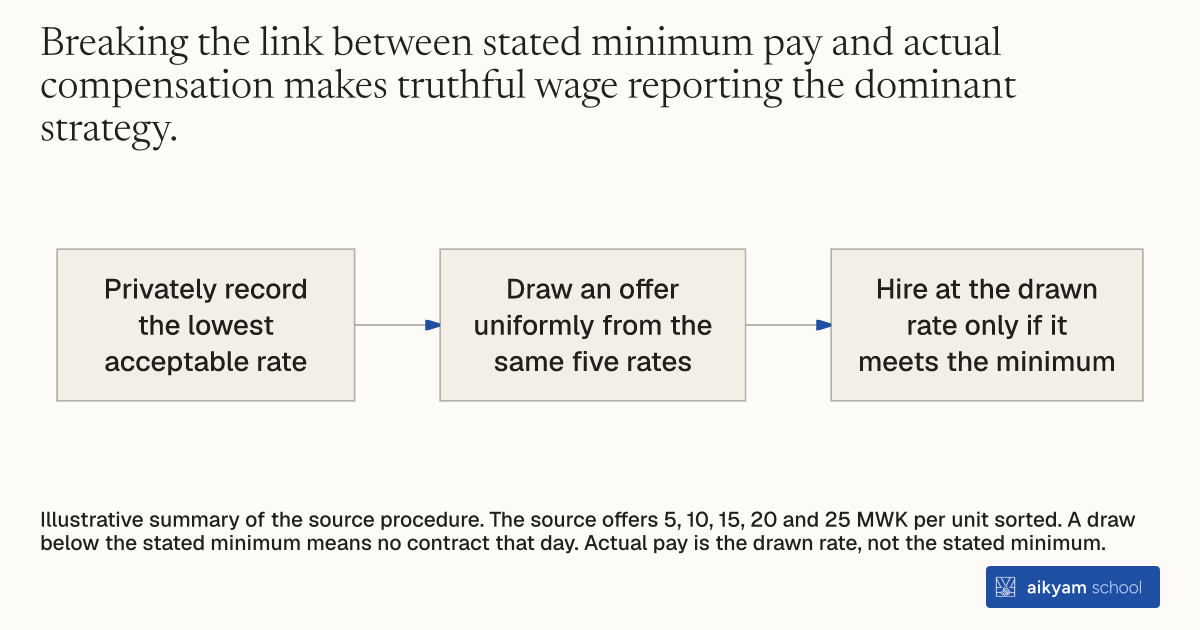
Research procedure
Elicit minimum acceptable piece rates
- Privately record the lowest acceptable rate
- Draw an offer uniformly from the same five rates
- Hire at the drawn rate only if it meets the minimum
Illustrative summary of the source procedure. The source offers 5, 10, 15, 20 and 25 MWK per unit sorted. A draw below the stated minimum means no contract that day. Actual pay is the drawn rate, not the stated minimum.
See source →How
When to use
Casual day-labor employers often do not know the lowest pay rate a worker will accept. Asking workers directly encourages them to overstate their minimum price to push up earnings. Eliciting true reservation wages helps employers design contracts that separate worker motivation from worker selection.
Elicit true reservation wages from day laborers by breaking the link between requested minimum pay and actual contract pay using a random draw.
- Present each worker in private with a menu of five discrete piece rates: 5, 10, 15, 20, and 25 MWK per unit sorted.
- Ask the worker to indicate which rates they will accept and record the lowest acceptable rate as their reservation wage.
- Have the worker draw a random piece rate offer from a uniform distribution across the same five piece rate options.
- Compare the drawn piece rate to the worker's stated reservation piece rate.
- Hire the worker at the drawn piece rate if the drawn rate meets or exceeds their stated reservation rate.
- Refuse contract hiring for that day if the drawn piece rate falls below the worker's stated reservation rate.
Why it works
Workers cannot raise their actual pay rate by bidding high and risk missing out on profitable daily work.
Example
Researchers tested this mechanism with 689 casual laborers across 12 villages in rural Malawi over four days per village. Over 60 percent of participants accepted piece rates as low as 10 MWK per unit, earning around 120 MWK daily including attendance pay. Ex-post contract refusal was under 3 percent and dropped over successive days as workers learned the game.
About the study
Participants
689 participants (66.5% female, average age 34.9 years) across 1,875 daily decisions in 12 villages in rural Malawi.
Study Design
Randomized field trial using a simplified Becker-DeGroot-Marschak mechanism across low and high labor demand seasons to observe labor supply and output quantity.
Results
Raising the piece rate by 10 MWK increases output quantity by 0.18 to 0.26 units sorted per day from a mean of 7.35 units, while minimum reservation wage displays a slightly negative or zero relationship with output.