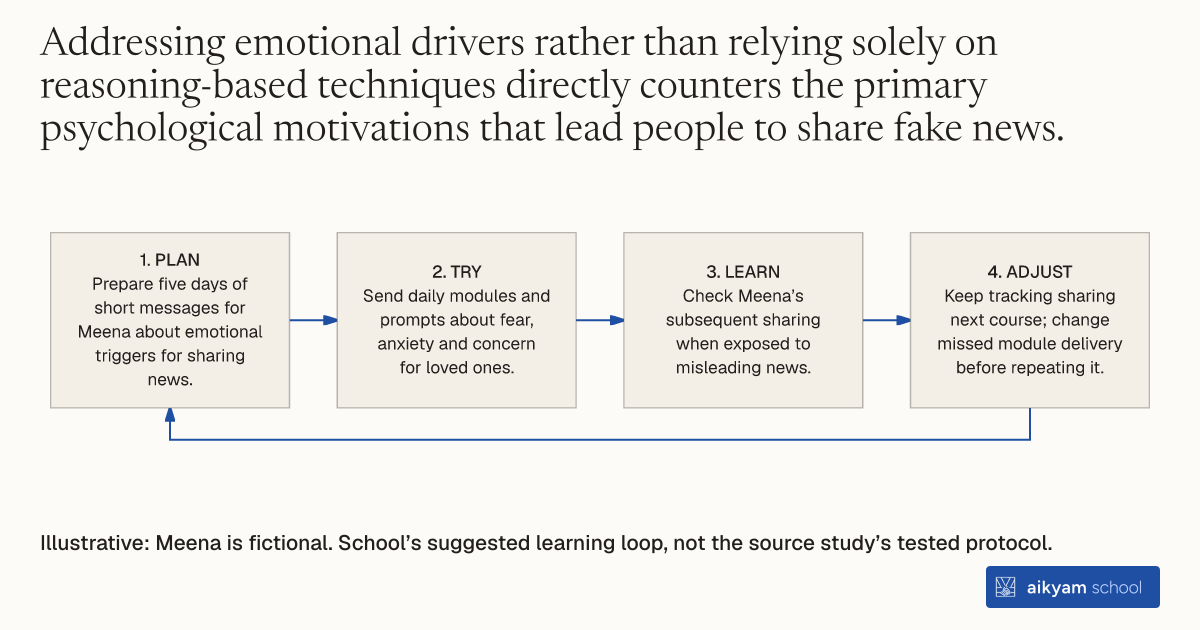
Try, learn and adjust
Check delivery of the emotional-sharing course
- Plan: Prepare five days of short messages for Meena about emotional triggers for sharing news.
- Try: Send daily modules and prompts about fear, anxiety and concern for loved ones.
- Learn: Check Meena’s subsequent sharing when exposed to misleading news.
- Adjust: Keep tracking sharing next course; change missed module delivery before repeating it.
Illustrative: Meena is fictional. School’s suggested learning loop, not the source study’s tested protocol.
See source →Module delivery and subsequent misinformation sharing. School’s suggested learning loop, not a source-tested cycle.
How
When to use
Citizens share online misinformation driven by emotional triggers such as fear, anger, or concern for family safety. Standard reasoning-based media literacy interventions fail to address these emotional motivations. This method helps media organizations and election communicators reduce fake news sharing on mobile networks.
Deliver short text-message educational courses addressing emotional drivers of misinformation sharing to mobile phone users over several days.
- Design a multi-day educational curriculum focused on emotional triggers behind fake news sharing.
- Develop short text messages highlighting how fear, anxiety, and concern for loved ones lead people to share unverified news.
- Establish a text-message distribution system to reach registered mobile subscribers.
- Send daily educational course modules directly to participants' mobile phones over a five-day period.
- Provide interactive prompts encouraging subscribers to reflect on their emotional reactions before sharing content.
- Evaluate participants' subsequent sharing behavior when exposed to misleading news items.
Example
In Kenya, researchers evaluated a five-day text-message-based educational course, finding that addressing emotional drivers reduced misinformation sharing more effectively than courses focusing only on reasoning-based techniques.
About the study
Participants
Mobile phone users and news consumers in Kenya.
Study Design
Randomized field experiment using text-message courses comparing emotional driver modules against reasoning-based modules and unexposed control groups.
Results
Decreased misinformation sharing, with larger reductions achieved when the course addressed emotional drivers rather than reasoning-based techniques alone.