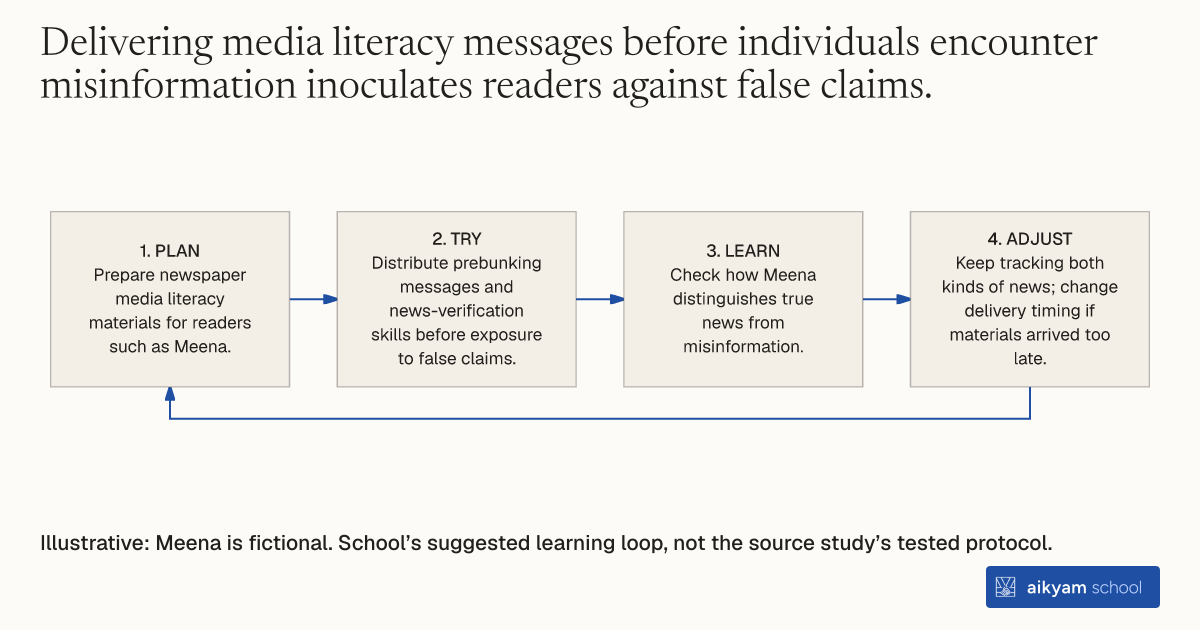
Try, learn and adjust
Check media literacy reaches readers before false claims
- Plan: Prepare newspaper media literacy materials for readers such as Meena.
- Try: Distribute prebunking messages and news-verification skills before exposure to false claims.
- Learn: Check how Meena distinguishes true news from misinformation.
- Adjust: Keep tracking both kinds of news; change delivery timing if materials arrived too late.
Illustrative: Meena is fictional. School’s suggested learning loop, not the source study’s tested protocol.
See source →Delivery timing and discernment of both true and false news. School’s suggested learning loop, not a source-tested cycle.
How
When to use
Citizens in democratic societies are exposed to political misinformation that distorts decisions and drives polarization. Fact-checking delivered after citizens see fake news can inadvertently increase skepticism toward accurate news. This method helps media organizations equip citizens to identify misinformation before encountering it without undermining trust in legitimate news.
Run an awareness and media literacy prebunking campaign in partnership with a national newspaper to inoculate readers against misinformation.
- Partner with an established national newspaper to design media literacy educational materials.
- Develop prebunking messages that explain common misinformation techniques and verification strategies.
- Distribute the inoculation materials through newspaper channels prior to voter exposure to false claims.
- Provide readers with practical skills to evaluate news credibility and identify false statements.
- Measure readers' subsequent ability to distinguish between true news and misinformation.
Why it works
Partnering with a credible national newspaper ensures the educational content is widely disseminated from a trusted source.
Example
In São Paulo, Brazil, researchers evaluated an awareness and media literacy campaign conducted in partnership with a national newspaper, which led respondents to better identify misinformation without increasing their skepticism toward true news.
About the study
Participants
News consumers and survey respondents in São Paulo, Brazil.
Study Design
Randomized field experiment evaluating multidimensional awareness and media literacy prebunking interventions delivered in partnership with a national newspaper.
Results
Led respondents to better identify misinformation without increasing their skepticism to true news.