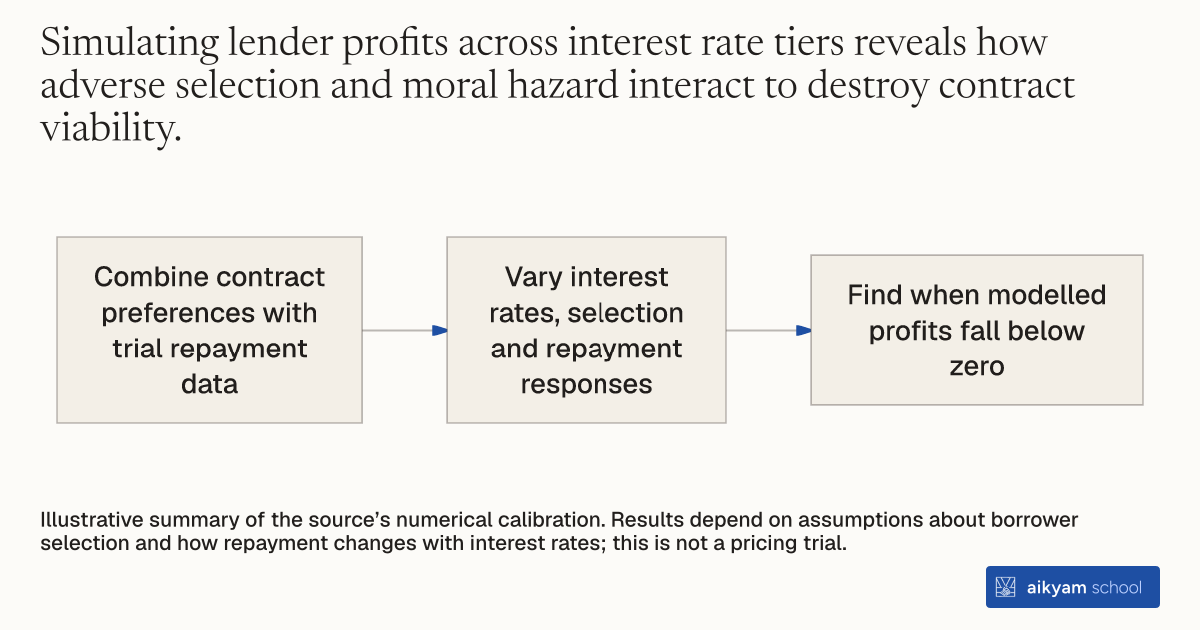
Research procedure
Model lender profits
- Combine contract preferences with trial repayment data
- Vary interest rates, selection and repayment responses
- Find when modelled profits fall below zero
Illustrative summary of the source’s numerical calibration. Results depend on assumptions about borrower selection and how repayment changes with interest rates; this is not a pricing trial.
See source →How
When to use
Microfinance institutions face financial losses when offering flexible loan terms because higher default rates reduce overall interest revenues. Lenders want to determine whether charging higher interest rates on grace period contracts can cover default costs without causing market collapse. Calibrating a numerical profit model allows financial planners to test if a stable zero-profit separating equilibrium exists under asymmetric information.
Calibrate microfinance institution profit equations using survey preference data and experimental default rates to evaluate interest rate pricing viability.
- Define baseline regular loan terms, including loan principal and an initial annual interest rate of 17.5 percent.
- Elicit borrower contract preferences and maximum willingness to pay across escalating grace period interest rate tiers using survey data.
- Calculate expected institution revenues by multiplying contract uptake proportions by experimental repayment rates at baseline interest rates.
- Adjust borrower repayment rates dynamically across interest rate tiers to incorporate adverse selection from self-selected client pools.
- Introduce moral hazard elasticity parameters to reduce repayment rates continuously as grace period interest rates rise.
- Solve for the threshold moral hazard elasticity that causes total institution profits from offering both debt contracts to fall below zero.
Why it works
Pricing flexible credit at higher interest rates drives away safe borrowers and encourages strategic default, preventing private lenders from breaking even.
Example
Researchers calibrated a profit model using survey preferences and experimental default data from 845 microfinance clients in Kolkata, India. The model showed that lenders could break even at a 37 percent interest rate without moral hazard, but identified that no zero-profit separating equilibrium exists when moral hazard elasticity exceeds 0.46.
About the study
Participants
845 female microfinance clients in 169 loan groups across Kolkata, India.
Study Design
Numerical model calibration combining experimental default rates and survey willingness-to-pay data to simulate MFI profits under adverse selection and moral hazard.
Results
Offering a grace period contract at 17.5 percent interest reduced MFI profits by 150 rupees per client, requiring an interest rate of 38 percent under adverse selection alone; incorporating moral hazard revealed that no separating equilibrium exists once repayment elasticity exceeds 0.46.