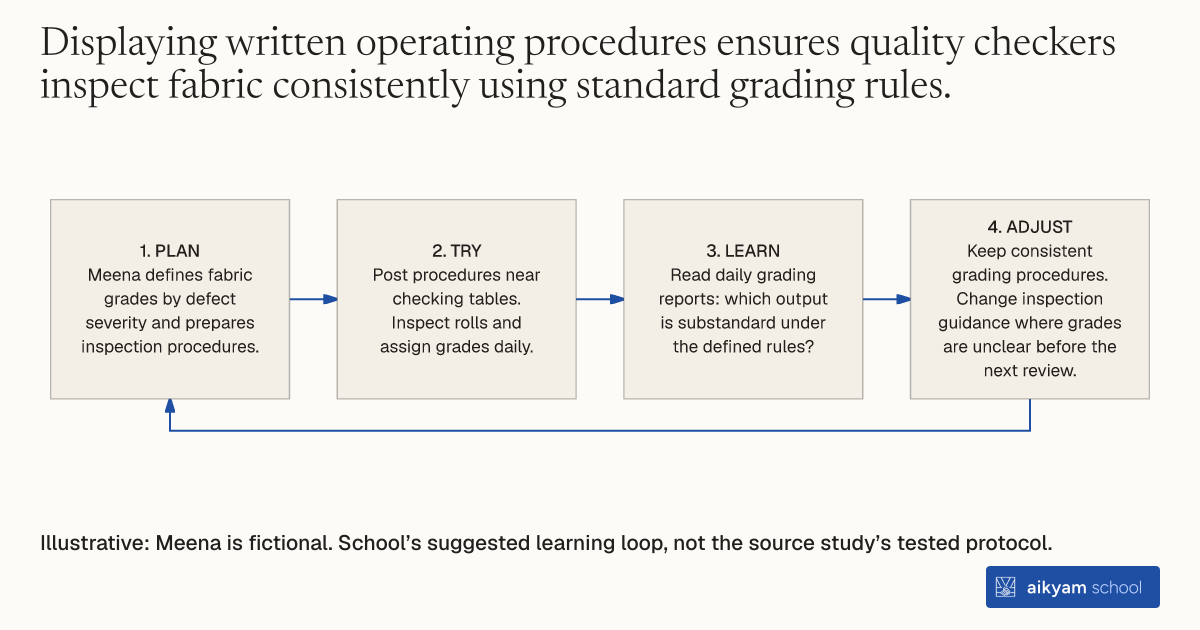
Try, learn and adjust
Check fabric inspection follows grading rules
- Plan: Meena defines fabric grades by defect severity and prepares inspection procedures.
- Try: Post procedures near checking tables. Inspect rolls and assign grades daily.
- Learn: Read daily grading reports: which output is substandard under the defined rules?
- Adjust: Keep consistent grading procedures. Change inspection guidance where grades are unclear before the next review.
Illustrative: Meena is fictional. School’s suggested learning loop, not the source study’s tested protocol.
See source →Observe grading reports, defect severity and displayed procedures. School suggests this learning loop; it is not the source’s tested procedure.
How
When to use
Textile plants often inspect fabric without clear gradation standards or displayed operating procedures for quality supervisors. Quality inspectors classify fabric inconsistently and lack standardized rules for catching errors, allowing defective fabric to reach buyers. This method helps plant directors set up a fabric gradation system and post written procedures for quality control staff.
Implement a formal fabric gradation system and display standard operating procedures for quality supervisors and checkers across factory floors.
- Operations managers establish a well-defined fabric gradation system that categorizes cloth rolls by defect severity.
- Quality teams draft written standard operating procedures specifying inspection criteria for quality supervisors and checkers.
- Factory staff display these written operating procedures near fabric checking tables on the floor.
- Quality supervisors use the displayed procedures daily to inspect fabric rolls and assign standardized quality grades.
- Plant managers review fabric gradation reports daily to identify substandard output and prevent flawed shipments.
Why it works
A well-defined fabric gradation system allows managers to track fabric quality accurately and categorize production by defect severity.
Example
International consultants helped Indian cotton textile plants near Mumbai establish a well-defined fabric gradation system and post standard operating procedures for quality checkers, raising fabric gradation adoption from 50.0% to 92.9% in treatment plants.
About the study
Participants
28 plants across 17 large, family-owned cotton textile weaving firms in Tarapur and Umbergaon near Mumbai, India, averaging 273 employees and \$7.45 million in annual sales per firm.
Study Design
Randomized controlled trial providing 11 treatment firms with 5 months of management consulting and 6 control firms with 1 month of diagnostic consulting, collecting weekly quality data across ~100 weeks.
Results
Adopting a well-defined fabric gradation system and quality supervisor procedures contributed to a 43.1% reduction in quality defects (p = 0.001), while raising adoption of displayed quality supervisor procedures from 0% to 42.9% in treatment plants.