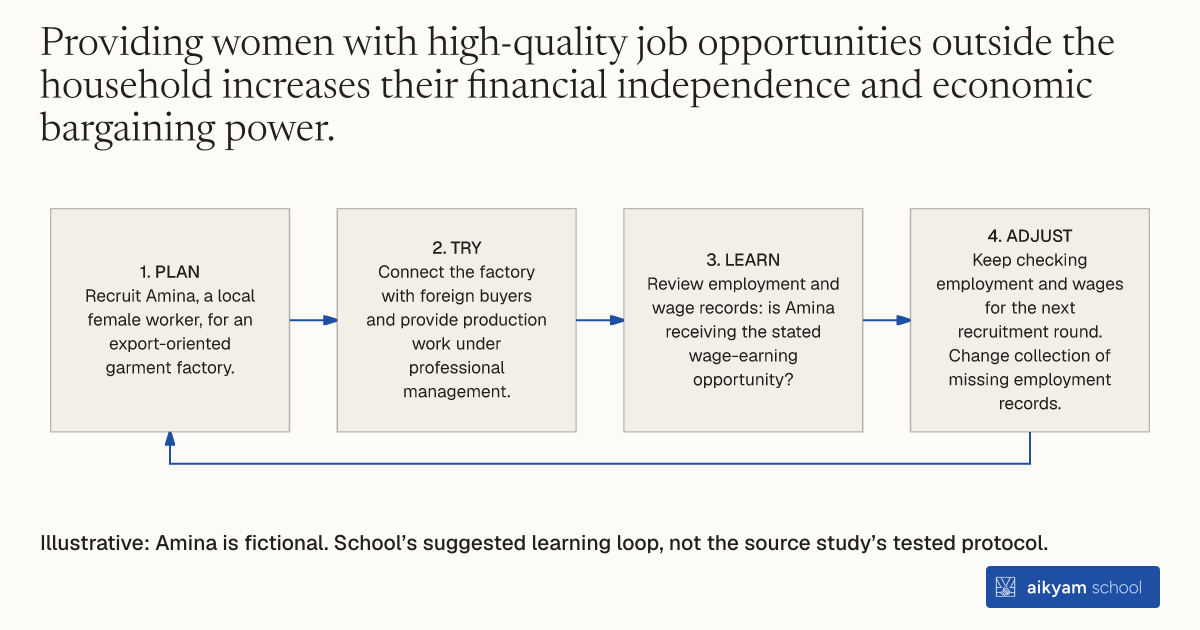
Try, learn and adjust
Check female recruitment into export manufacturing
- Plan: Recruit Amina, a local female worker, for an export-oriented garment factory.
- Try: Connect the factory with foreign buyers and provide production work under professional management.
- Learn: Review employment and wage records: is Amina receiving the stated wage-earning opportunity?
- Adjust: Keep checking employment and wages for the next recruitment round. Change collection of missing employment records.
Illustrative: Amina is fictional. School’s suggested learning loop, not the source study’s tested protocol.
See source →School’s suggested, untested loop. Observe jobs and wage income; this loop does not establish empowerment or domestic violence effects.
How
When to use
Women in lower-income countries often face limited formal economic opportunities and financial dependence within households. High-quality jobs outside the home are scarce, which contributes to low female empowerment and elevated domestic violence in local communities. Expanding export manufacturing sectors creates formal jobs for female workers, improving household welfare and female autonomy.
Expand formal employment opportunities for women by integrating domestic garment manufacturing factories into export markets.
- Industrial policymakers and foreign investors establish export-oriented garment manufacturing facilities in designated industrial areas.
- Factory managers recruit and employ local female workers to staff production and assembly lines.
- Garment factories establish export supply connections with international corporate buyers and foreign markets.
- Exporting factories adopt professional management practices and provide steady wage-earning opportunities for female employees.
- Female workers earn independent incomes outside the household, elevating their economic autonomy and status within surrounding communities.
Why it works
Operating within better-managed export manufacturing sectors enhances female empowerment and lowers household tension, resulting in decreased domestic violence.
Example
In Myanmar, expanding garment export manufacturing created jobs for female workers, which increased female empowerment and reduced domestic violence in nearby communities.
About the study
Participants
Female workers and households in surrounding communities of garment export manufacturing factories in Myanmar.
Study Design
Quasi-experimental study evaluating female employment, empowerment metrics, and household outcomes near exporting garment factories.
Results
Linking garment export factories to foreign buyers created job opportunities for women, increased female empowerment, and led to a drop in domestic violence in nearby communities.