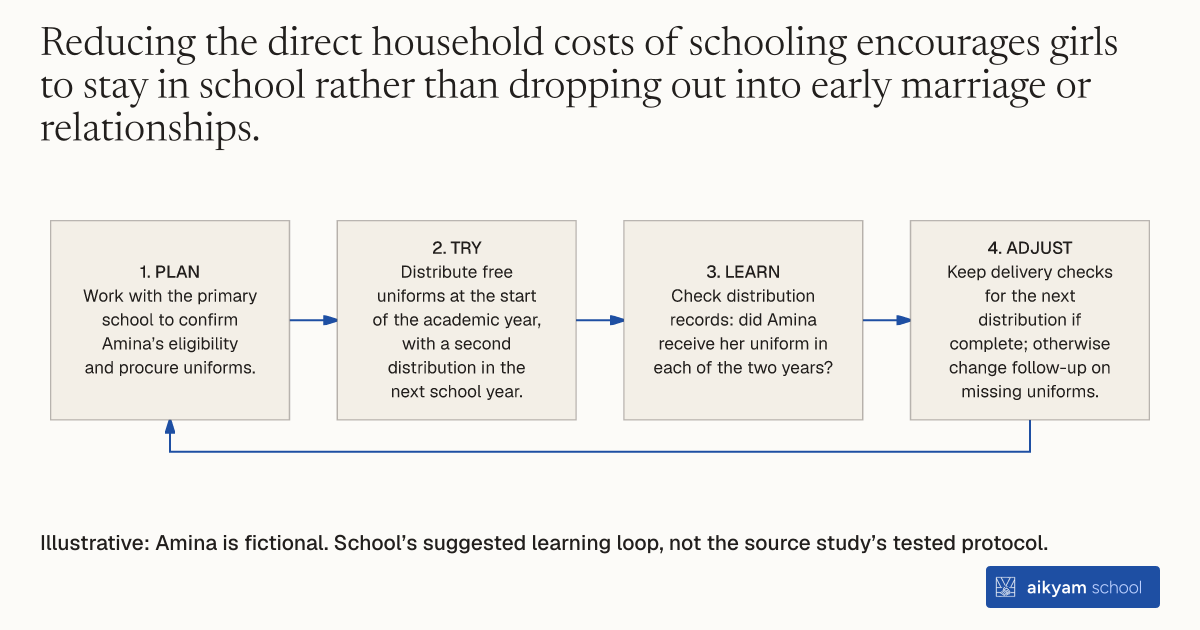
Try, learn and adjust
Check eligible students receive school uniforms
- Plan: Work with the primary school to confirm Amina’s eligibility and procure uniforms.
- Try: Distribute free uniforms at the start of the academic year, with a second distribution in the next school year.
- Learn: Check distribution records: did Amina receive her uniform in each of the two years?
- Adjust: Keep delivery checks for the next distribution if complete; otherwise change follow-up on missing uniforms.
Illustrative: Amina is fictional. School’s suggested learning loop, not the source study’s tested protocol.
See source →School’s suggested, untested learning loop. Observe eligibility and uniform receipt across two consecutive years; no schooling or pregnancy outcome is assumed.
How
When to use
Adolescent female students in primary school face financial barriers that increase their likelihood of dropping out and entering early relationships. Lowering the indirect costs of education keeps girls enrolled and reduces vulnerability to pregnancy and early marriage. This approach targets upper primary female students at risk of leaving school due to educational costs.
Subsidize school participation by distributing free school uniforms directly to eligible primary school students.
- Program administrators partner with local primary schools to identify eligible upper primary female students.
- Administrators procure standardized school uniforms from local manufacturers or vendors.
- School staff distribute free school uniforms directly to selected female students at the start of the academic year.
- Staff repeat the uniform distribution for a second consecutive school year to maintain educational support.
Why it works
Maintaining student status creates a protective environment where pregnant dropouts and forced early unions are avoided.
Example
In Kenya from 2003 to 2010, distributing free school uniforms for two consecutive years to eighth-grade female students reduced adolescent pregnancy by 3 percentage points (17 percent), from 16 percent to 13 percent.