Try, learn and adjust
Check teacher training reaches classroom practice
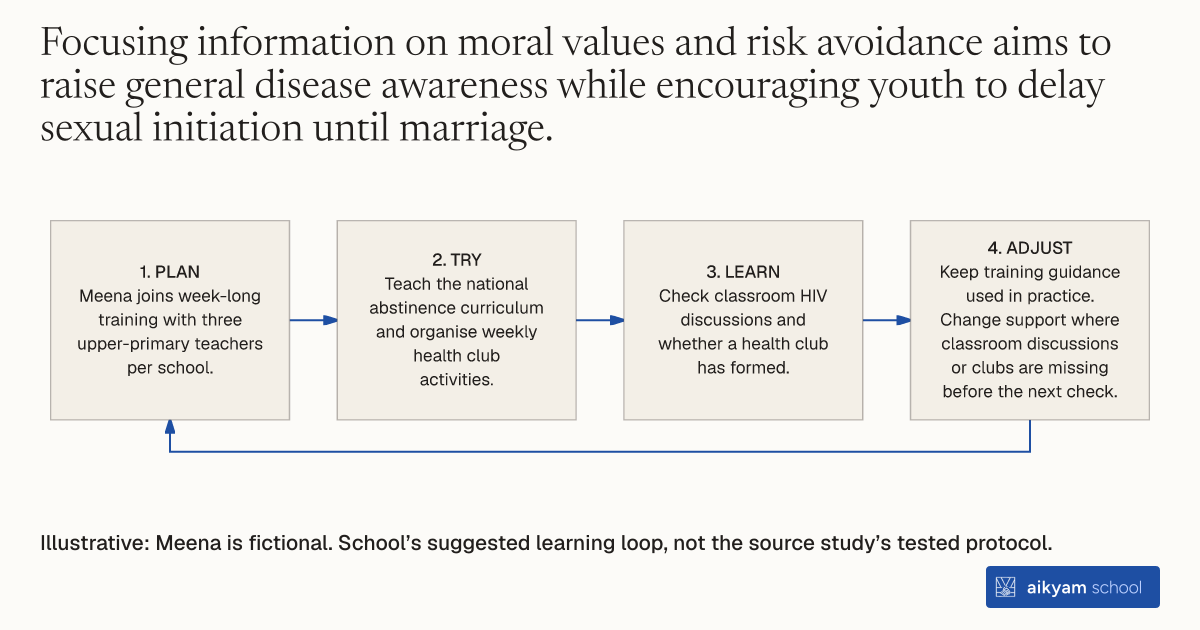
- Plan: Meena joins week-long training with three upper-primary teachers per school.
- Try: Teach the national abstinence curriculum and organise weekly health club activities.
- Learn: Check classroom HIV discussions and whether a health club has formed.
- Adjust: Keep training guidance used in practice. Change support where classroom discussions or clubs are missing before the next check.
Illustrative: Meena is fictional. School’s suggested learning loop, not the source study’s tested protocol.
See source →Observe teaching and club formation. School suggests this learning loop; the study found no statistically significant change in teen pregnancy.
How
When to use
Many African primary schools lack trained instructors to deliver national HIV prevention education to sexually maturing adolescents. School systems need a structured strategy to build educator capacity in delivering standardized health lessons. This approach equips primary teachers with the skills to teach national abstinence topics before students become sexually active.
Prepare primary school educators to teach the national abstinence curriculum and establish school health clubs through structured in-service workshops.
- Ministry facilitators and NGO trainers conduct multiple week-long in-service training sessions for three upper-primary teachers per school.
- Trainers instruct teachers on the official national curriculum covering HIV biology, transmission risks, and moral refusal skills focused on abstinence until marriage.
- Facilitators provide teachers with regional HIV prevalence estimates and guide them on discussing epidemic impacts in class.
- Instructors receive practical guidance to form school health clubs that reinforce risk avoidance through student role plays and active learning.
- Trained teachers deliver classroom instruction and lead weekly health club activities across upper-primary grade levels.
Why it works
Restricting instruction to complete abstinence seeks to eliminate exposure to pre-marital sexual health risks.
Example
In Bungoma and Butere/Mumias districts in Western Kenya, government and NGO facilitators trained three upper-primary teachers across 163 primary schools in 2003. Within a year, 86 percent of these schools formed active health clubs, and trained teachers were 50 percent more likely to discuss HIV in class.
About the study
Participants
328 primary schools (163 treatment schools and 165 control schools) in Western Kenya, covering primary students in grade 8 with an average age of 15 years.
Study Design
A randomized controlled trial evaluated the teacher training program by comparing school-level HIV instruction frequency, student knowledge scores, and 12-month teen pregnancy rates between treatment and control groups.
Results
The training increased student HIV knowledge scores and raised teacher weekly HIV discussions by 50 percent, but generated no statistically significant change in teen pregnancy rates (0.6 percentage point increase).