Try, learn and adjust
Check small insurance units match the purchase
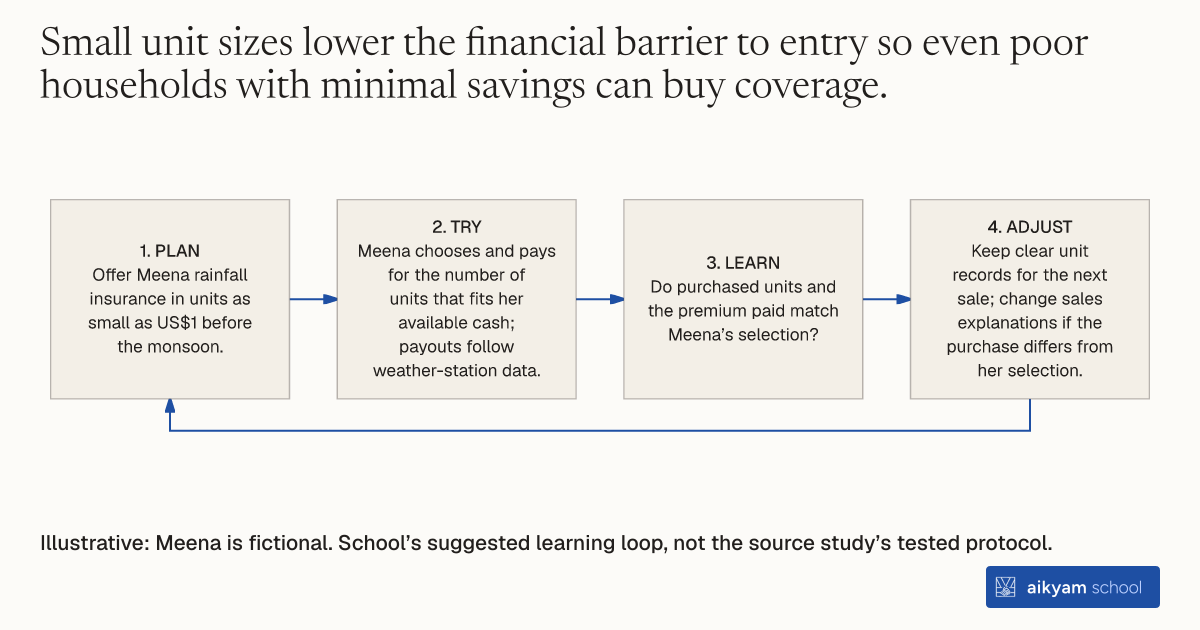
- Plan: Offer Meena rainfall insurance in units as small as US$1 before the monsoon.
- Try: Meena chooses and pays for the number of units that fits her available cash; payouts follow weather-station data.
- Learn: Do purchased units and the premium paid match Meena’s selection?
- Adjust: Keep clear unit records for the next sale; change sales explanations if the purchase differs from her selection.
Illustrative: Meena is fictional. School’s suggested learning loop, not the source study’s tested protocol.
See source →School’s suggested learning loop, not a tested source procedure. Observe unit choice, payment and station-based terms; maximum potential payout is INR 3,000 (US$76.56) per household, not a guaranteed payment.
How
When to use
Farmers and agricultural laborers rely on unpredictable monsoon rains, but standard insurance policies require high upfront payments. Dividing policy costs into tiny units allows cash-strapped households to buy small amounts of coverage. This gives low-income rural families flexible access to formal weather risk protection.
Divide index insurance coverage into granular, low-cost policy units to make risk protection affordable for poor households.
- Local institutions structure weather index policies into small unit sizes starting as low as US\$1 before the monsoon season.
- Sales agents offer these small policy units directly to rural farmers and landless laborers in target villages.
- Household buyers select and pay for the exact number of small policy units that fit their current cash reserves.
- Local weather stations measure actual seasonal rainfall levels throughout the covered monsoon period.
- Underwriters distribute automated payouts based on station weather data up to a maximum potential payout of INR 3,000 (US\$76.56) per household.
Why it works
Purchasing small units lets families match insurance protection directly to their limited cash on hand.
Example
In Andhra Pradesh and Gujarat, BASIX and SEWA sold rainfall insurance policies in unit sizes as small as US\$1 to rural households across 87 villages, offering potential payouts up to INR 3,000 (US\$76.56).
About the study
Participants
3,804 households in 50 villages in Gujarat and 1,047 households in 37 villages in Andhra Pradesh, India.
Study Design
Randomized controlled trial evaluating demand responses to policy design, randomized price discounts, marketing schemes, and educational visits.
Results
Structuring policies into unit sizes as small as US\$1 enabled poor households to purchase insurance, while demand remained price-sensitive and influenced by non-price barriers.