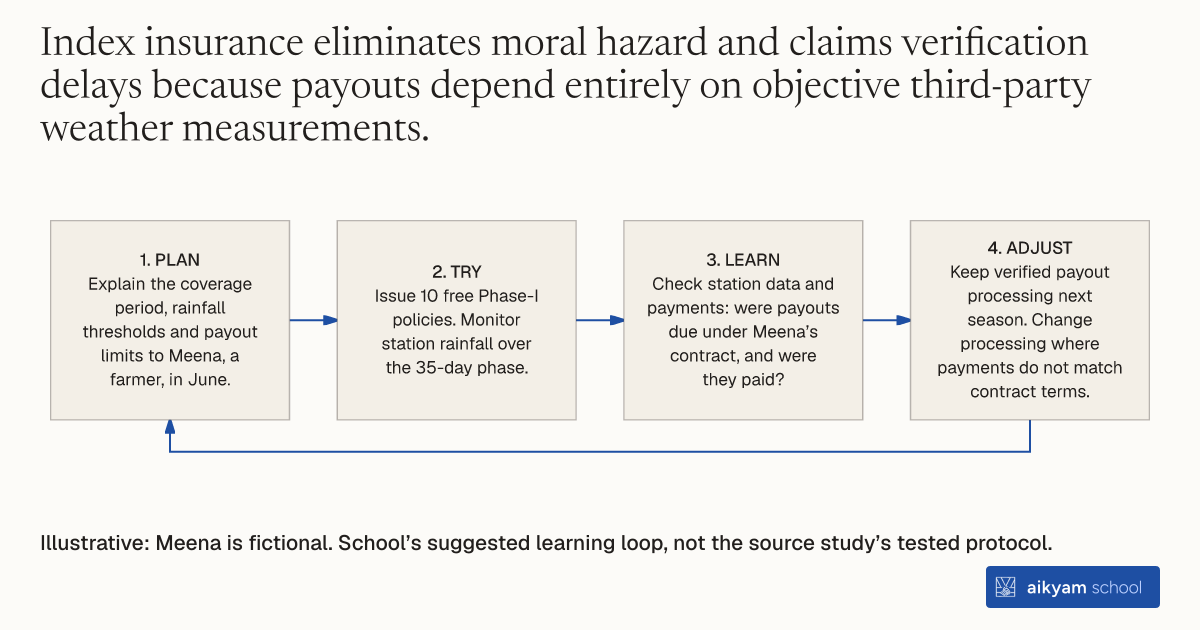
Try, learn and adjust
Check rainfall policy delivery and payouts
- Plan: Explain the coverage period, rainfall thresholds and payout limits to Meena, a farmer, in June.
- Try: Issue 10 free Phase-I policies. Monitor station rainfall over the 35-day phase.
- Learn: Check station data and payments: were payouts due under Meena’s contract, and were they paid?
- Adjust: Keep verified payout processing next season. Change processing where payments do not match contract terms.
Illustrative: Meena is fictional. School’s suggested learning loop, not the source study’s tested protocol.
See source →School’s suggested, untested loop. Observe policy receipt, recorded rainfall and payments due under the contract. This is not a test of crop effects.
How
When to use
Smallholder farmers in semi-arid regions face extreme weather volatility, forcing them to select low-risk, low-yield subsistence crops to avoid catastrophic loss. Traditional individual crop insurance incurs prohibitively high verification and monitoring costs. Program managers provide index-based weather insurance policies to smallholder producers at the start of the planting season to mitigate uninsurable weather risk and encourage investment in higher-return cash crops.
Distribute index-based rainfall insurance policies directly to agricultural producers prior to the monsoon sowing period to shield household investments against drought.
- Partner with an underwriter to design Phase-I rainfall index policies linked to regional weather stations that pay out linearly when cumulative rainfall falls below defined thresholds during the 35-day sowing period.
- Visit target farming households individually in June at the onset of the monsoon season.
- Explain the contract parameters, including the policy coverage period, strike threshold, exit threshold, and maximum payout values.
- Issue 10 Phase-I insurance policies per household free of charge, providing coverage for early-season rainfall deficits.
- Monitor official third-party weather station rain gauge data throughout the 35-day policy phase.
- Process and disburse automatic linear financial payouts directly to insured policyholders following the release of verified weather data if deficit thresholds are breached.
Why it works
By hedging catastrophic weather risk ex ante, the insurance reduces background risk and enables risk-averse farmers to reallocate land and capital into higher-yielding cash crops.
Example
ICRISAT enumerators provided 10 Phase-I rainfall insurance policies underwritten by ICICI Lombard (combined market value of Rs. 1,000) to 740 treatment households across 45 villages in Mahbubnagar and Anantapur, Andhra Pradesh, India, in June 2009. Provision of the policies increased the probability of planting higher-yielding cash crops (castor and groundnut) by 6 percentage points (a 12% relative increase) and increased cash crop land allocation by 0.163 log acres (a 27% increase for a 2-acre baseline).
About the study
Participants
1,479 smallholder farming households across 45 villages in Mahbubnagar and Anantapur, Andhra Pradesh, India (740 treatment households, 739 control households); 54% unschooled, average landholding 5.37 acres.
Study Design
Randomized Controlled Trial evaluating agricultural input expenditures and land allocation between farmers receiving 10 free insurance policies and control farmers receiving promised cash compensation of Rs. 350.
Results
Insurance provision increased the likelihood of planting cash crops by 6 percentage points (p = 0.041), increased log land cultivated for cash crops by 0.163 (p = 0.021), and increased log input expenditures on cash crops by 0.800 (p = 0.039).