Try, learn and adjust
Check guaranteed flood credit information
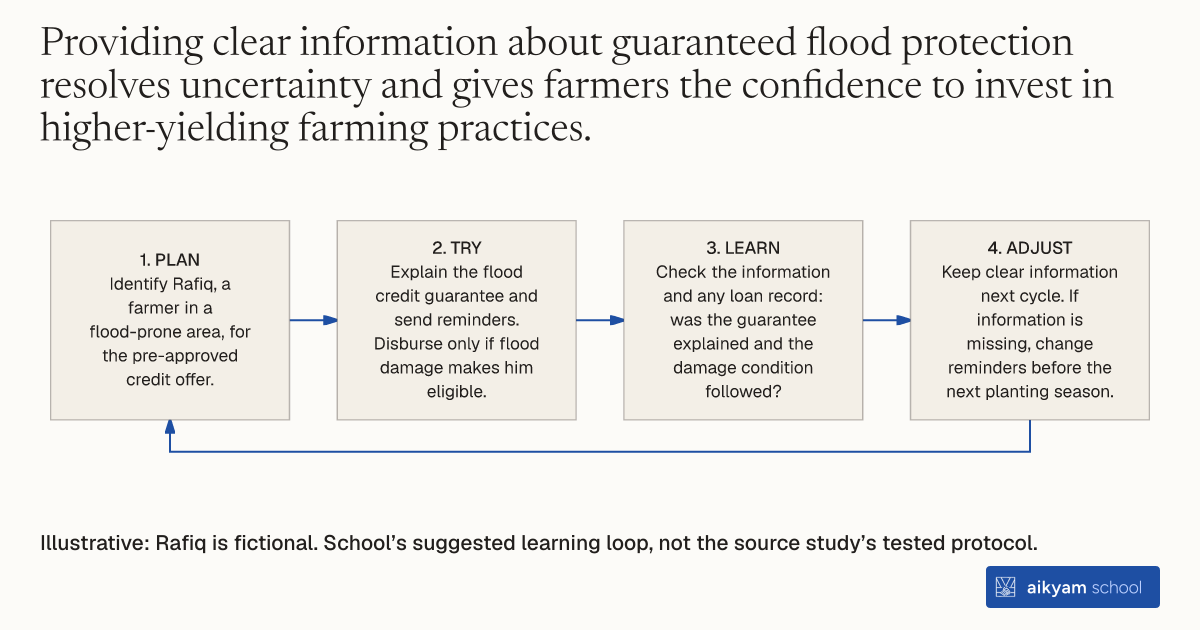
- Plan: Identify Rafiq, a farmer in a flood-prone area, for the pre-approved credit offer.
- Try: Explain the flood credit guarantee and send reminders. Disburse only if flood damage makes him eligible.
- Learn: Check the information and any loan record: was the guarantee explained and the damage condition followed?
- Adjust: Keep clear information next cycle. If information is missing, change reminders before the next planting season.
Illustrative: Rafiq is fictional. School’s suggested learning loop, not the source study’s tested protocol.
See source →School’s suggested, untested learning loop. Observe guarantee information, eligibility and loan take-up. Do not assume borrowing or increased investment.
How
When to use
Small-scale farming households in flood-prone regions face recurring risk of flood damage. Uninsured flood risk leads farmers to underinvest in agricultural land and inputs due to fear of crop losses. Offering a guaranteed loan product in the event of a flood protects farmers against disaster loss and encourages upfront agricultural investment.
Offer farming households pre-approved emergency credit guarantees through trusted institutions to encourage upfront agricultural investments.
- Nonprofit organizations identify farming households operating in flood-prone agricultural regions.
- Program managers inform households that they are pre-approved to receive a simple credit product if a flood occurs.
- Field staff deliver regular information and reminders to participating farmers about their guaranteed credit protection.
- Farmers increase upfront investments by renting additional agricultural land and applying pest controls during the planting season.
- Lenders disburse loan funds to eligible farmers only if a flood damages their crops.
Example
A trusted nonprofit offered a guaranteed flood credit product to farming households in flood-prone areas of Bangladesh. Farmers receiving guaranteed credit information increased rented agricultural land by 27 percent and applied more pesticides, even though loan take-up remained low.