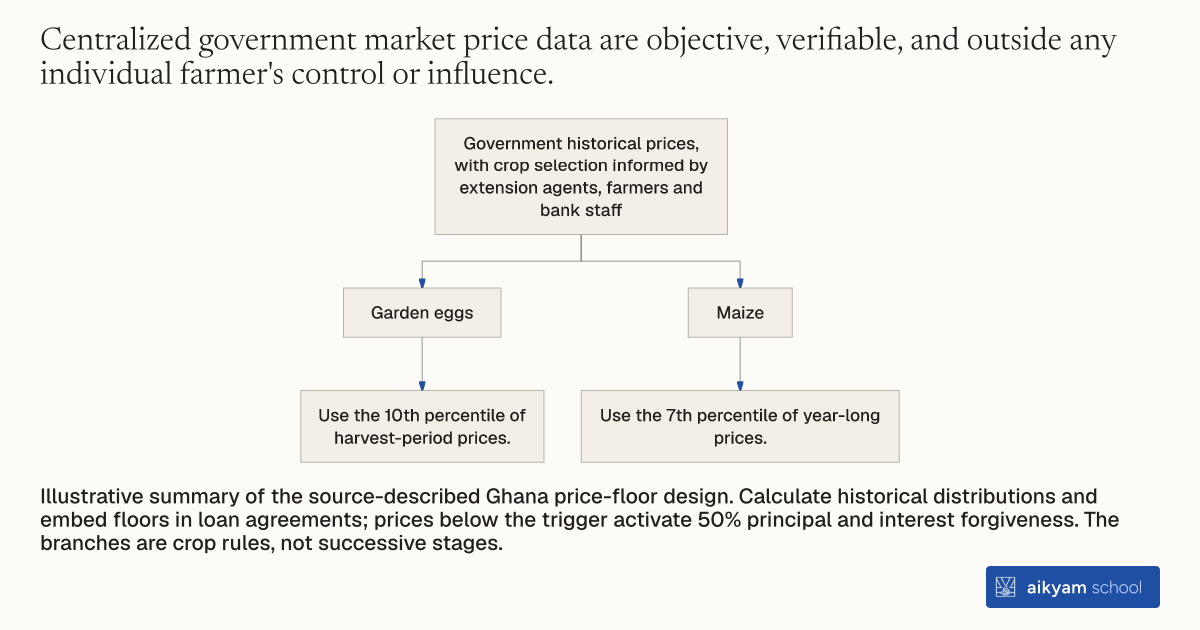
Price-floor design
Set crop-specific price floors
Government historical prices, with crop selection informed by extension agents, farmers and bank staff
- Garden eggs
- Use the 10th percentile of harvest-period prices.
- Maize
- Use the 7th percentile of year-long prices.
Illustrative summary of the source-described Ghana price-floor design. Calculate historical distributions and embed floors in loan agreements; prices below the trigger activate 50% principal and interest forgiveness. The branches are crop rules, not successive stages.
See source →How
When to use
This method applies when designing index-based agricultural microinsurance or indemnified credit products for smallholder farmers. It solves the problem of setting objective debt-forgiveness price floors that reflect genuine market collapses without creating moral hazard. The approach helps program managers establish clear trigger criteria using historical market data.
Establish crop price indemnity trigger floors by analyzing historical government market price data to set crop-specific percentile thresholds.
- Program managers collect historical market price data for target crops from the government Ministry of Agriculture.
- Program leaders consult with agricultural extension agents, farmers, and rural bank management to select prevalent crops with high price volatility.
- Analysts calculate historical price distributions for each crop during key post-harvest sales periods.
- Program officers set the price floor for perishable crops at the 10th percentile of harvest-period prices and for storable staples at the 7th percentile of year-long historical prices.
- Program staff embed these exact price floors into loan agreements to define the threshold below which 50% debt forgiveness triggers.
Why it works
Tying loan forgiveness to historical percentiles provides target risk coverage while keeping the product financially viable for lenders.
Example
In rural Eastern Ghana, researchers and Mumuadu Rural Bank used Ministry of Agriculture data to set indemnity price floors at the 10th percentile of historical harvest-period prices for garden eggs and the 7th percentile of year-long prices for maize.
About the study
Participants
169 smallholder farmers (91 maize farmers, 78 garden egg farmers) across 5 villages in rural Eastern Ghana.
Study Design
Pilot microcredit experiment indexing a 50% principal and interest debt forgiveness clause to historical Ministry of Agriculture market price thresholds.
Results
Indemnity floors set at the 7th percentile for maize and 10th percentile for garden eggs achieved 91.7% loan take-up in treatment groups, encouraging a 17.5 percentage point increase in garden egg cultivation (p < 0.05).