Try, learn and adjust
Check business assets reach the recipient
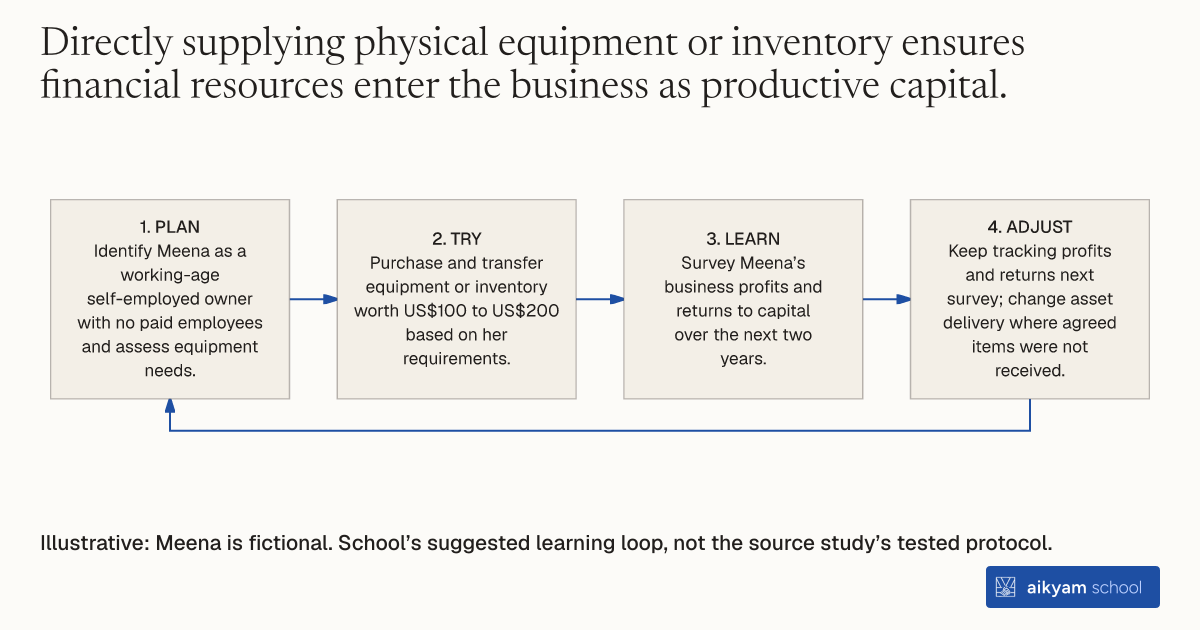
- Plan: Identify Meena as a working-age self-employed owner with no paid employees and assess equipment needs.
- Try: Purchase and transfer equipment or inventory worth US$100 to US$200 based on her requirements.
- Learn: Survey Meena’s business profits and returns to capital over the next two years.
- Adjust: Keep tracking profits and returns next survey; change asset delivery where agreed items were not received.
Illustrative: Meena is fictional. School’s suggested learning loop, not the source study’s tested protocol.
See source →School’s suggested, untested loop. Observe asset receipt, profits and returns over two years; no profit gain is assumed.
How
When to use
Micro-entrepreneurs often lack capital to purchase physical equipment or inventory needed for business expansion. Direct cash grants may sometimes be diverted to non-business expenses or family enterprises. Program managers and researchers use in-kind capital grants to deliver physical business assets directly to microenterprise owners.
Provide in-kind capital grants of business equipment or inventory directly to self-employed micro-entrepreneurs.
- Identify self-employed working-age micro-entrepreneurs who have no paid employees.
- Assess the specific equipment or inventory needs of target micro-enterprises in low-income communities.
- Purchase business equipment or inventory valued between US\$100 and US\$200 based on recipient requirements.
- Transfer the physical equipment or inventory directly to the micro-entrepreneur.
- Survey business owners over the next two years to measure impacts on profits and returns to capital.
Why it works
In households where a woman is the sole entrepreneur, these physical assets stay within her firm and generate high financial returns.
Example
Researchers offered in-kind grants of equipment or inventory valued between US\$100 and US\$200 to 793 micro-entrepreneurs in Ghana, where female sole entrepreneurs achieved returns on par with male business owners in multi-enterprise households.
About the study
Participants
408 micro-entrepreneurs in Sri Lanka and 793 micro-entrepreneurs in Ghana with no paid employees.
Study Design
Randomized controlled trial comparing self-employed micro-entrepreneurs offered in-kind grants of equipment or inventory, cash grants, or no grants over two years.
Results
In Sri Lanka, grants increased profits by 30 percent for female sole business owners but had no effect on profits across all female business owners; in Ghana, female sole entrepreneurs earned returns from in-kind grants equal to those of male entrepreneurs in multi-enterprise households.