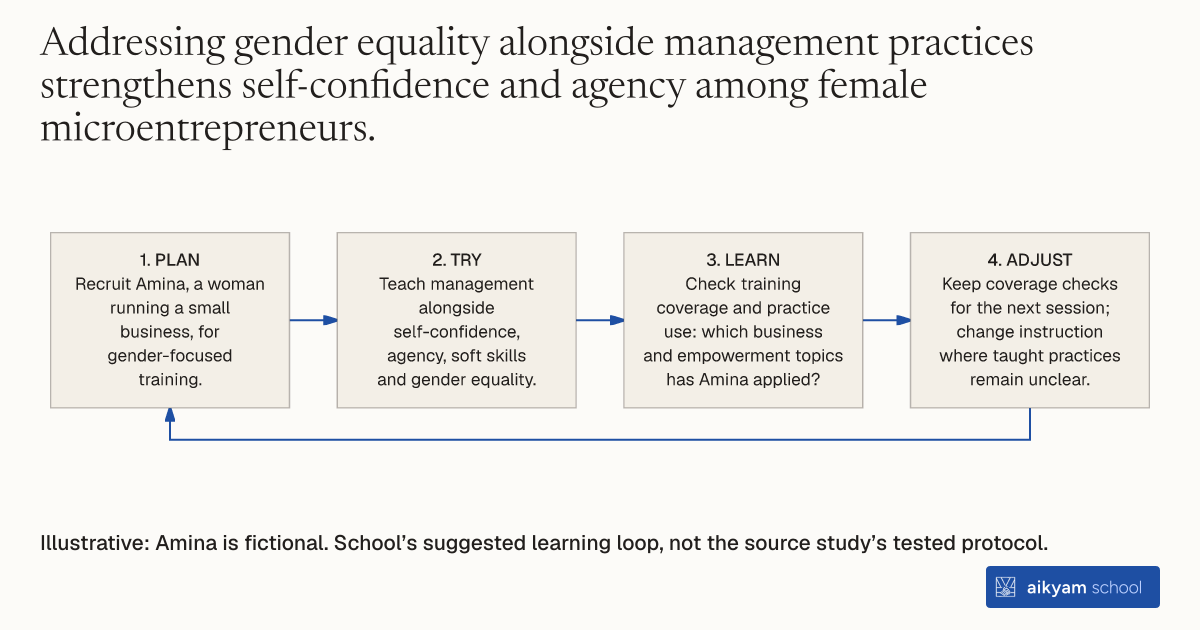
Try, learn and adjust
Check business and empowerment content
- Plan: Recruit Amina, a woman running a small business, for gender-focused training.
- Try: Teach management alongside self-confidence, agency, soft skills and gender equality.
- Learn: Check training coverage and practice use: which business and empowerment topics has Amina applied?
- Adjust: Keep coverage checks for the next session; change instruction where taught practices remain unclear.
Illustrative: Amina is fictional. School’s suggested learning loop, not the source study’s tested protocol.
See source →School’s suggested, untested learning loop. Observe training topics and practice use; a profit gain is not assumed for Amina.
How
When to use
Female microentrepreneurs often face gender-specific barriers like restrictive social norms, household obligations, and lower self-confidence that hinder traditional business training impact. Standard accounting courses fail to address these social and cultural constraints. Combining standard business concepts with empowerment topics helps female enterprise owners build agency and commercial growth.
Combine standard business training modules with additional content on agency, gender equality, and self-confidence for female business owners.
- Program administrators select women microentrepreneurs operating small businesses in low-income settings.
- Instructors assemble participants for structured gender-focused training sessions.
- Trainers deliver standard business skills modules covering core management principles.
- Instructors teach supplemental modules focused on building female self-confidence, agency, and soft skills.
- Participants complete training units addressing gender equality and social barriers in business environments.
- Female entrepreneurs apply soft skills and business practices to expand commercial operations.
Why it works
This combined approach enables female owners to overcome restrictive social norms and deploy business practices more effectively.
Example
In Kenya, female energy entrepreneurs received gender-focused empowerment business training, raising their weekly profits by 15.4 percent three years after the intervention.
About the study
Participants
Female microentrepreneurs evaluated across five studies in low- and middle-income countries, including Peru and Kenya.
Study Design
Randomized controlled trials measuring sales and profits of female-owned businesses following gender-focused business training.
Results
Four out of five studies showed improvements in women's business outcomes; training access increased sales for women entrepreneurs in Peru 7 to 10 months after implementation and raised weekly profits in Kenya by 15.4 percent (US\$2.63) above comparison profits three years post-intervention.