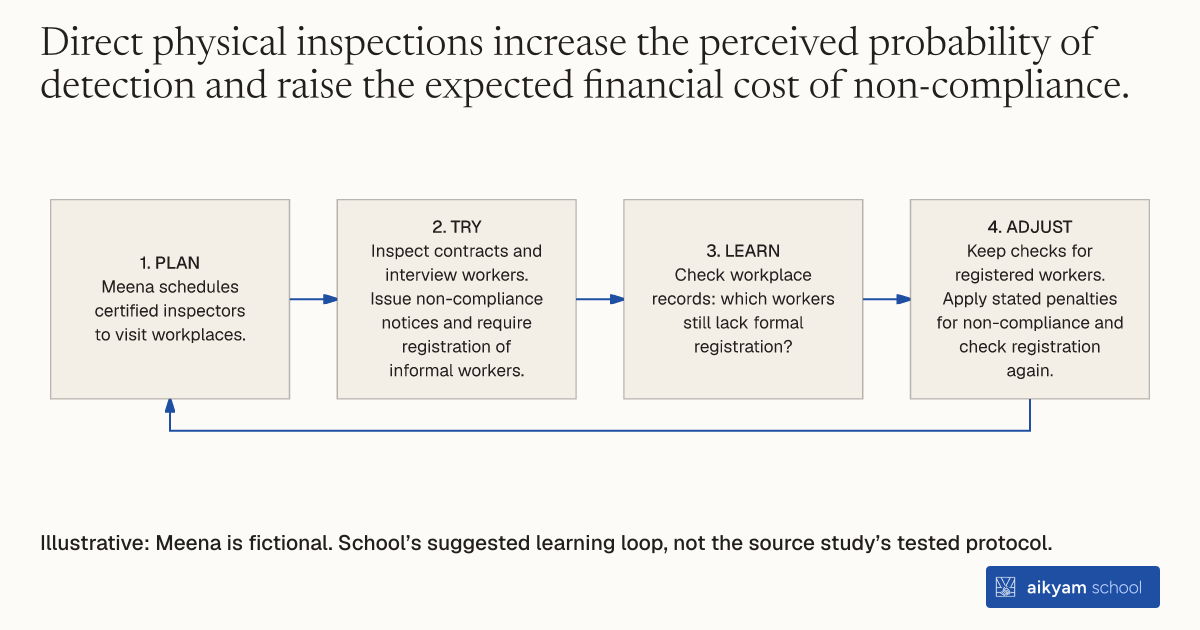
Try, learn and adjust
Check worker registration after workplace inspections
- Plan: Meena schedules certified inspectors to visit workplaces.
- Try: Inspect contracts and interview workers. Issue non-compliance notices and require registration of informal workers.
- Learn: Check workplace records: which workers still lack formal registration?
- Adjust: Keep checks for registered workers. Apply stated penalties for non-compliance and check registration again.
Illustrative: Meena is fictional. School’s suggested learning loop, not the source study’s tested protocol.
See source →Observe employment contracts, inspection notices and worker registration. School suggests this learning loop; it is not the source’s tested procedure.
How
When to use
Informal employers avoid registering workers because the perceived risk of legal enforcement is low. This situation leaves employees without legal protections and social security coverage. It applies to labor inspectorates seeking to increase compliance with formal employment regulations.
Conduct direct physical visits to enterprise premises to inspect labor compliance and mandate worker formalization.
- Schedule physical visits by certified labor inspectors to workplace locations.
- Audit workplace records and interview workers on site to verify formal employment contracts.
- Issue official non-compliance notices to employers operating with informal staff.
- Mandate the immediate formal registration of informal workers.
- Apply administrative fines or legal penalties to non-compliant business owners.
Why it works
Employers respond by registering informal workers to avoid legal fines.
Example
In Brazil, labor authorities deployed inspectors to conduct in-person workplace visits, which increased worker formalization across inspected businesses.
Source
See source →Evidence in Labor Market Policies and Implications for Brazil: Informality
Copyright © 2025 Inter-American Development Bank.
Full source notice
Copyright © 2025 Inter-American Development Bank ("IDB"). This work is subject to a Creative Commons license CC BY 3.0 IGO (https://creativecommons.org/licenses/by/3.0/igo/legalcode). The terms and conditions indicated in the URL link must be met and the respective recognition must be granted to the IDB. Further to section 8 of the above license, any mediation relating to disputes arising under such license shall be conducted in accordance with the WIPO Mediation Rules. Any dispute related to the use of the works of the IDB that cannot be settled amicably shall be submitted to arbitration pursuant to the United Nations Commission on International Trade Law (UNCITRAL) rules. The use of the IDB's name for any purpose other than for attribution, and the use of IDB's logo shall be subject to a separate written license agreement between the IDB and the user and is not authorized as part of this license. Note that the URL link includes terms and conditions that are an integral part of this license.