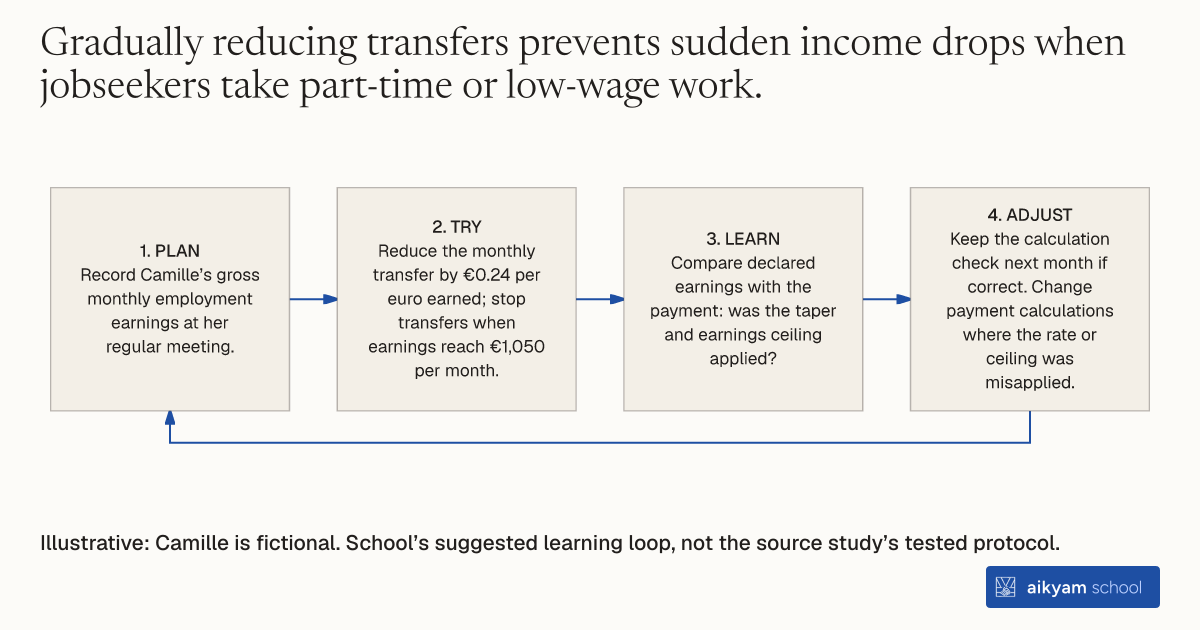
Try, learn and adjust
Check transfer reductions match reported earnings
- Plan: Record Camille’s gross monthly employment earnings at her regular meeting.
- Try: Reduce the monthly transfer by €0.24 per euro earned; stop transfers when earnings reach €1,050 per month.
- Learn: Compare declared earnings with the payment: was the taper and earnings ceiling applied?
- Adjust: Keep the calculation check next month if correct. Change payment calculations where the rate or ceiling was misapplied.
Illustrative: Camille is fictional. School’s suggested learning loop, not the source study’s tested protocol.
See source →School’s suggested, untested loop. Observe earnings, the 24% taper and the €1,050 monthly ceiling; do not infer that tapering increased work.
How
When to use
Social cash transfer programs face the risk that beneficiaries lose all monetary benefits as soon as they earn any job income, creating an abrupt work disincentive. Taper rules gradually reduce cash transfers as earnings rise to encourage participants to take short-term work. This method applies a linear benefit reduction schedule to maintain partial income support for working youth.
Apply a linear taper schedule that reduces monthly cash transfers against earned income up to a baseline earnings ceiling.
- Counselors require working participants to declare their gross monthly employment earnings at each regular meeting.
- Administrative staff calculate the recipient's monthly wage relative to the national monthly minimum wage ceiling of €1,050.
- Program systems reduce the participant's maximum monthly cash transfer by €0.24 for every euro earned from labor.
- Program staff disburse the adjusted net transfer amount to the participant while total earnings remain below the minimum wage threshold.
- Administrative staff phase out cash transfer payments entirely once monthly job earnings reach or exceed €1,050.
Why it works
This schedule allows working participants to retain a portion of their cash allowance alongside job earnings.
Example
In France, 2,661 young jobseekers receiving up to €250 per month had their benefits reduced linearly by €0.24 per euro earned up to the €1,050 monthly minimum wage, resulting in an implicit marginal tax rate of 24% that temporarily reduced full-time employment by 3 percentage points in the first six months.
About the study
Participants
2,661 young jobseekers assigned to cash transfers and 2,837 control participants across 82 Job Youth Centers in France, where baseline monthly income averaged €77.
Study Design
Randomized controlled trial evaluating monthly transfer adjustments based on participant earnings reported in administrative records and survey tracking over 24 months.
Results
The 24% implicit marginal tax rate caused a short-term decrease in full-time employment of 3 percentage points (ITT -0.18 months of total employment in the first six months, p < 0.05), though this disincentive effect disappeared after six months when maximum monthly stipends began digressing.