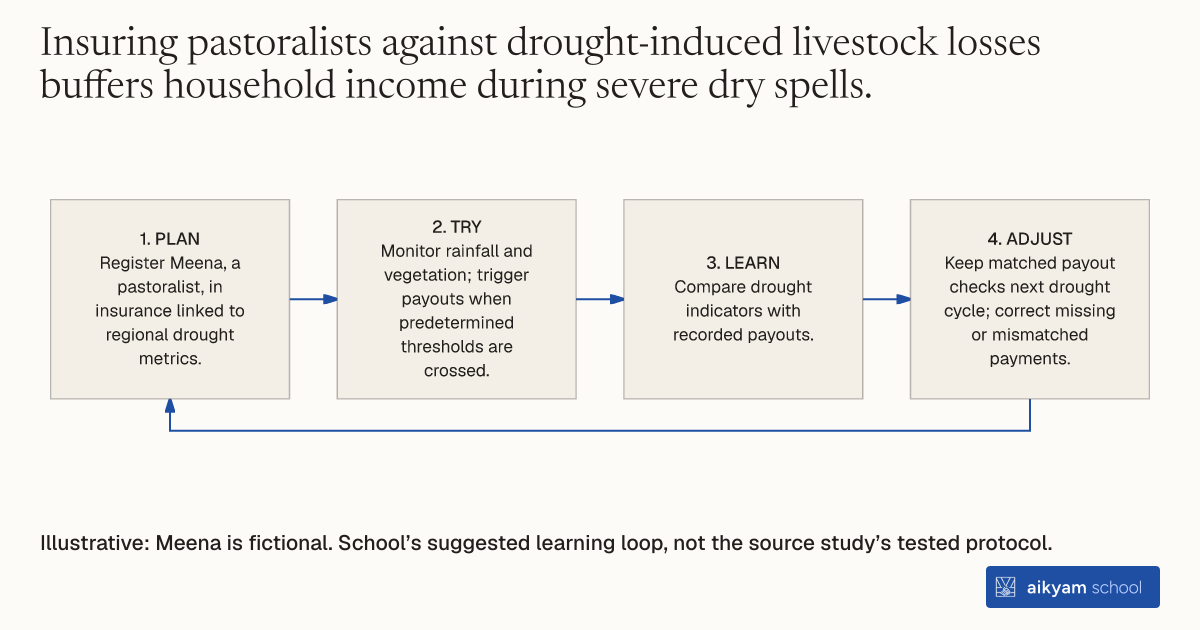
Try, learn and adjust
Check insurance payouts follow the drought index
- Plan: Register Meena, a pastoralist, in insurance linked to regional drought metrics.
- Try: Monitor rainfall and vegetation; trigger payouts when predetermined thresholds are crossed.
- Learn: Compare drought indicators with recorded payouts.
- Adjust: Keep matched payout checks next drought cycle; correct missing or mismatched payments.
Illustrative: Meena is fictional. School’s suggested learning loop, not the source study’s tested protocol.
See source →Index thresholds and payout receipt; no threshold value or individual conflict outcome is supplied. School’s suggested learning loop, not a source-tested cycle.
How
When to use
Pastoralist communities in drought-prone regions face severe livestock mortality and income shocks during extreme dry spells. Climate-induced income losses force pastoralists to migrate or compete over scarce grazing lands, increasing local conflict risks. This method applies to social protection agencies seeking to buffer pastoralists against drought shocks and mitigate conflict.
Provide index-based livestock insurance payout coverage tied to regional drought thresholds.
- Program managers establish an index-based livestock insurance scheme linked to regional weather and drought metrics.
- Pastoralist herdsmen register for insurance coverage across vulnerable rural regions.
- Automated satellite and meteorological systems monitor regional rainfall levels and vegetation indices.
- The insurance program triggers automated financial payouts to pastoralists when drought indicators cross predetermined thresholds.
- Pastoralists use insurance funds to purchase animal feed, manage income losses, and reduce forced migration in Kenya and Ethiopia.
Why it works
Income smoothing reduces the need for forced migration, which mitigates competition and conflict over scarce grazing lands.
Example
In Kenya and Ethiopia, quasi-experimental evaluations of index-based livestock insurance programs found that insurance payouts decreased drought-related conflict by reducing migratory pressures and helping pastoralists manage negative income shocks.
About the study
Participants
Pastoralists and rural households in Kenya and Ethiopia.
Study Design
Quasi-experimental evaluations of two index-based livestock insurance programs evaluating drought-related conflict and income smoothing.
Results
Index-based livestock insurance decreased drought-related conflict by reducing migratory pressures and helping pastoralists manage negative income shocks.