Try, learn and adjust
Check payouts follow the rainfall contract
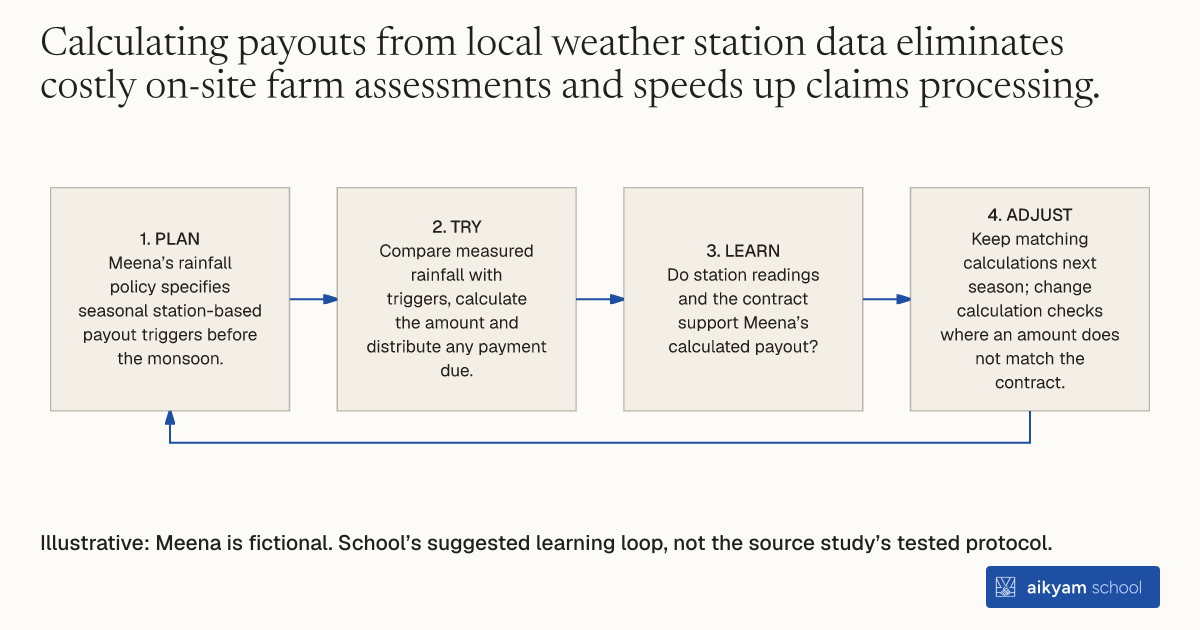
- Plan: Meena’s rainfall policy specifies seasonal station-based payout triggers before the monsoon.
- Try: Compare measured rainfall with triggers, calculate the amount and distribute any payment due.
- Learn: Do station readings and the contract support Meena’s calculated payout?
- Adjust: Keep matching calculations next season; change calculation checks where an amount does not match the contract.
Illustrative: Meena is fictional. School’s suggested learning loop, not the source study’s tested protocol.
See source →School’s suggested learning loop, not a tested source procedure. Observe station readings, triggers and payments; the maximum potential payout is INR 3,000 (US$76.56), not compensation for each farm’s measured loss.
How
When to use
Agricultural households face erratic monsoon rainfall that threatens seasonal crop yields and family income. Traditional indemnity insurance requires costly individual farm damage assessments after severe weather shocks. Executing automated insurance payouts based on local weather station rainfall metrics provides rapid and objective financial relief.
Execute weather index insurance payouts using local weather station measurement data to relieve agricultural risk.
- Insurance providers set seasonal rainfall threshold triggers before the upcoming monsoon season.
- Local weather stations measure actual rainfall amounts throughout the covered monsoon period.
- Insurers compare station weather data directly against established index contract triggers.
- Underwriters calculate payout amounts up to a maximum potential payout of INR 3,000 (US\$76.56) per household.
- Institutions distribute cash payouts to covered rural policyholders based on weather station index breaches.
Why it works
Objective rainfall measurement prevents disputes and reassures farmers that payouts depend directly on observed weather metrics.
Example
In Andhra Pradesh and Gujarat, BASIX and SEWA offered rainfall index insurance policies with payouts determined by local weather station rainfall recordings, capping maximum potential payouts at INR 3,000 (US\$76.56) per household across 87 villages.
About the study
Participants
3,804 households in 50 villages in Gujarat and 1,047 households in 37 villages in Andhra Pradesh, India.
Study Design
Randomized controlled trial evaluating rainfall insurance adoption and longitudinal tracking of payout impacts across rural villages.
Results
Payouts were based on rainfall recorded at local weather stations up to INR 3,000 (US\$76.56), and observing a local village payout of INR 1,000 per policy in the previous year increased the probability of purchasing insurance by 29 to 50 percentage points in the following year.