Research procedure
Assess informal insurance before marketing
- Identify household sub-caste networks
- Measure support for personal and shared shocks
- Compare network strength and insurance demand
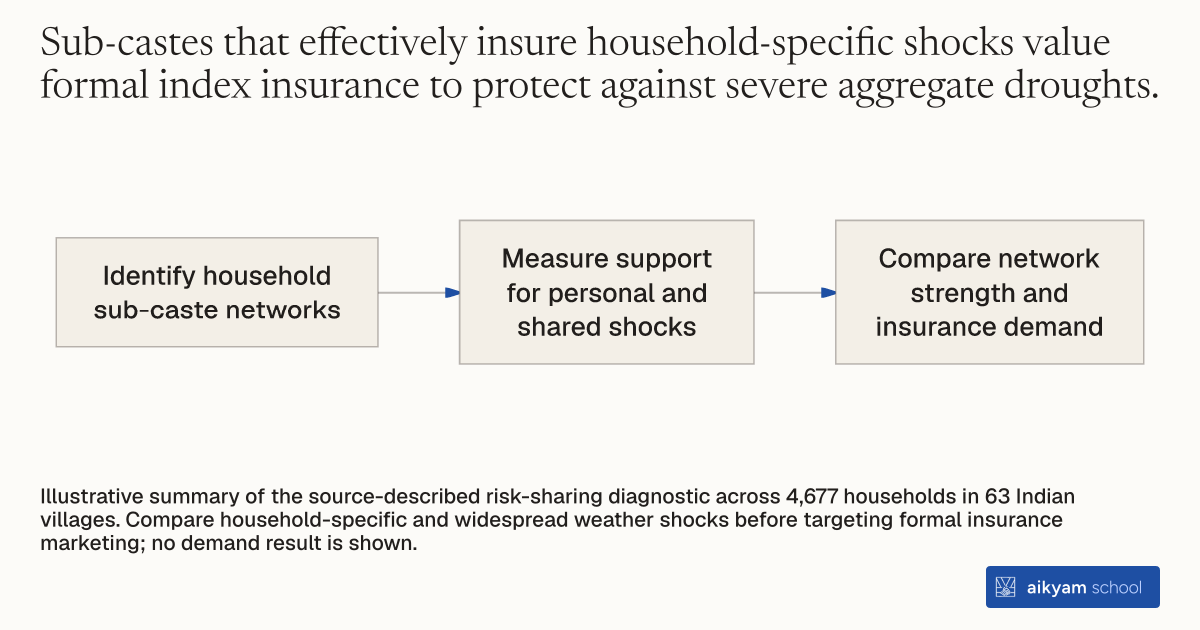
Illustrative summary of the source-described risk-sharing diagnostic across 4,677 households in 63 Indian villages. Compare household-specific and widespread weather shocks before targeting formal insurance marketing; no demand result is shown.
See source →How
When to use
Rural agrarian communities rely on informal sub-caste (jati) networks to pool risk and manage household shocks. When designing formal microinsurance programs, practitioners must diagnose existing informal risk-sharing arrangements to avoid introducing redundant products. Measuring sub-caste network capacity helps program managers determine whether formal insurance complements or substitutes for informal risk protection.
Assess sub-caste network characteristics across target communities to evaluate pre-existing informal risk sharing before introducing formal financial products.
- Identify the sub-caste (jati) affiliations of all households participating in agricultural baseline surveys.
- Measure the extent to which each sub-caste network provides informal support for household-specific shocks like illness or theft.
- Measure the capacity of each sub-caste network to protect members against broad aggregate shocks like regional droughts.
- Compare informal network strength against household demand for formal index insurance offering varying levels of basis risk.
- Target formal insurance marketing toward sub-castes that effectively handle idiosyncratic risk but lack coverage for widespread weather shocks.
Why it works
Conversely, sub-castes capable of mitigating aggregate shocks view formal index contracts as redundant, leading to lower demand.
Example
Researchers assessed sub-caste risk-sharing capacity across 4,677 farming households in 63 villages in India before offering rainfall index insurance. Households belonging to sub-castes with strong coverage for household-specific risks purchased more formal insurance when policies carried basis risk. Members of sub-castes capable of managing aggregate weather shocks were significantly less likely to buy formal contracts.
About the study
Participants
4,677 farming households across 63 villages in Tamil Nadu, Andhra Pradesh, and Uttar Pradesh, India.
Study Design
Randomized evaluation combining sub-caste risk-sharing network assessments with randomized insurance discount offers and weather station distance variations.
Results
Members of sub-castes capable of providing support during aggregate shocks were significantly less likely to purchase formal monsoon insurance, whereas members of sub-castes good at handling idiosyncratic shocks bought more insurance despite basis risk.