Try, learn and adjust
Check factory inventory against records
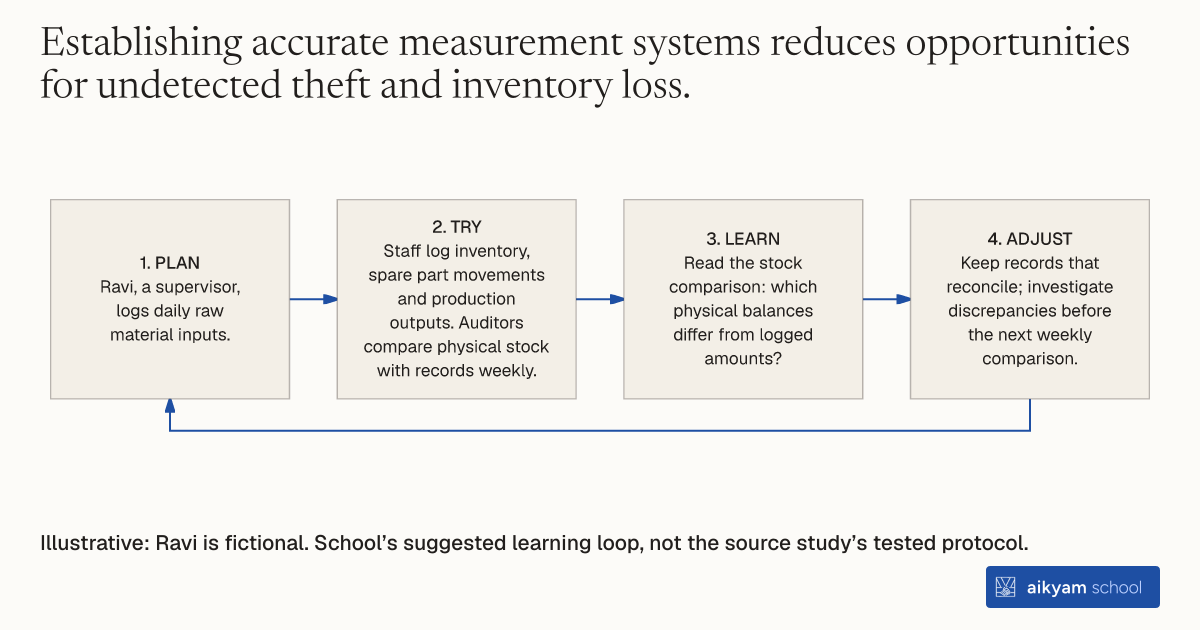
- Plan: Ravi, a supervisor, logs daily raw material inputs.
- Try: Staff log inventory, spare part movements and production outputs. Auditors compare physical stock with records weekly.
- Learn: Read the stock comparison: which physical balances differ from logged amounts?
- Adjust: Keep records that reconcile; investigate discrepancies before the next weekly comparison.
Illustrative: Ravi is fictional. School’s suggested learning loop, not the source study’s tested protocol.
See source →School’s suggested loop, not a tested source procedure. Observe inputs, outputs, inventory and spare parts. A discrepancy alone does not establish theft.
How
When to use
Enterprise owners in developing countries hesitate to delegate decision-making authority to middle managers due to fear of unpunished theft. Operating without systematic recordkeeping makes undetected theft easier for employees and managers. This method establishes structured measurement systems for tracking factory inputs, production outputs, spare parts, and inventory.
Implement structured data tracking systems to record operational inputs, outputs, inventory, and spare parts across manufacturing plants.
- Production line supervisors log raw material inputs received at factory floors daily.
- Warehouse staff record inventory levels and spare part movements in centralized tracking logs.
- Factory managers log finished product outputs at every stage of assembly.
- Internal auditors compare physical inventory balances against recorded log entries weekly to detect discrepancies.
Why it works
Transparent data tracking provides owners with the monitoring visibility needed to delegate authority safely.
Example
Manufacturing firms in developing countries like Brazil, China, and India lacked good data systems for measuring outputs, inputs, inventories, and spares. This absence of data systems increased undetected theft risks and severely restricted managerial decentralization compared to developed-country counterparts.
About the study
Participants
6,000 medium-sized manufacturing firms (100 to 5,000 employees) across the United States, Europe, Japan, Brazil, China, and India.
Study Design
Cross-country double-blind organizational survey measuring management practices and managerial delegation.
Results
Firms in developing countries lacked data systems for tracking inputs, outputs, inventories, and spares, directly increasing theft opportunities and reducing delegation relative to firms in rich countries.