Research steps
Instrument school enrolment in demand analysis
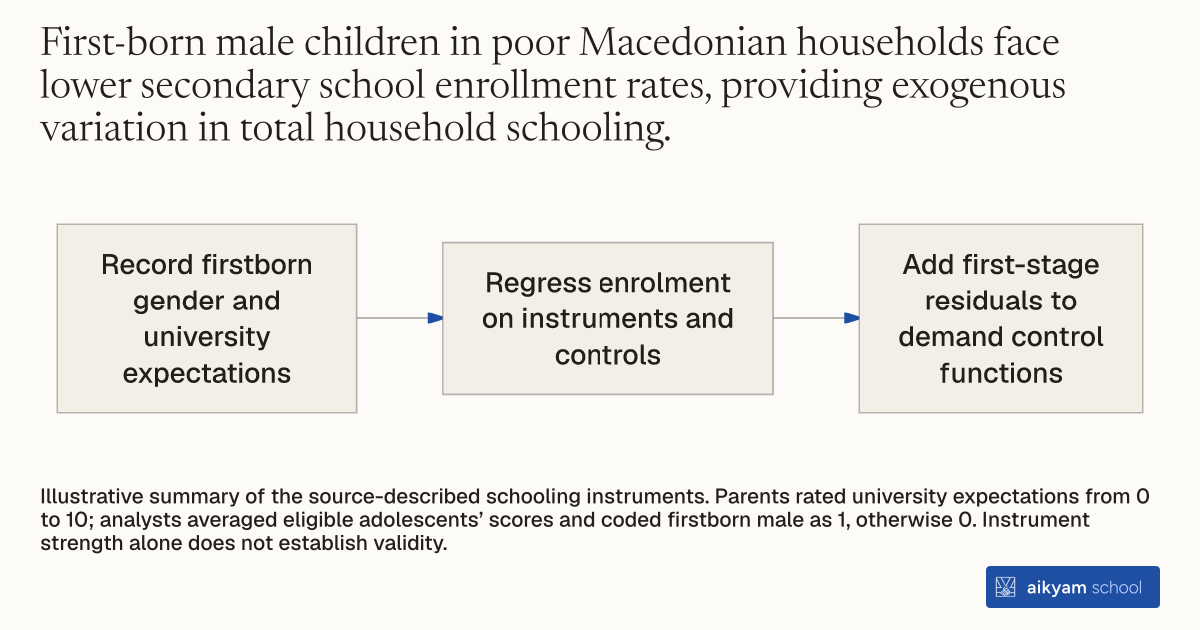
- Record firstborn gender and university expectations
- Regress enrolment on instruments and controls
- Add first-stage residuals to demand control functions
Illustrative summary of the source-described schooling instruments. Parents rated university expectations from 0 to 10; analysts averaged eligible adolescents’ scores and coded firstborn male as 1, otherwise 0. Instrument strength alone does not establish validity.
See source →How
When to use
Estimating demand systems for households receiving conditional cash transfers requires controlling for school enrollment decisions. Schooling choices are endogenous because unobserved family preferences influence both spending patterns and child education. Instrumenting the number of enrolled children using firstborn gender and parental university expectations isolates school enrollment effects from unobserved preference shocks.
Instrument the number of children enrolled in school using firstborn gender composition and parental expectations of university attendance.
- Survey baseline households to determine the gender of the first-born child in each family.
- Ask respondents to report on a 0-to-10 scale the expected probability that their children will attend university.
- Compute the average university probability score across eligible adolescent children at the household level.
- Construct a binary indicator variable equal to 1 if the first-born child is male and 0 otherwise.
- Regress the number of children enrolled in school on the male first-born indicator, expected university probability, and demographic controls in the first stage.
- Extract the first-stage residuals and incorporate them into second-stage control functions for household demand equations.
Why it works
Parental expectations of university attendance correlate strongly with secondary enrollment without directly driving short-term food basket choices.
Example
In Macedonia, economists instrumented the number of enrolled children for 816 households using firstborn male status and expected university attendance probability. First-stage OLS regressions showed that a male first-born decreased enrolled children by 0.144, while each unit increase in university probability increased enrollment by 0.461, producing a partial F-statistic of 18.83.
About the study
Participants
1053 households with children aged 14 to 18 sampled at baseline across 84 municipalities in Macedonia, with 830 households followed up after two years. Households averaged 4.5 members and 55 percent were Muslim.
Study Design
A randomized trial across all 84 municipalities in Macedonia, stratified by population size into 42 mother-recipient municipalities and 42 household-head-recipient municipalities. First-stage OLS regressions instrumented school enrollment using a male first-born dummy and parental university expectations on a 0-to-10 scale.
Results
Male first-born status reduced school enrollment by 0.144 children, while expected university probability increased enrollment by 0.461 children. The partial F-statistic for the schooling instruments reached 18.833, validating instrument strength in the demand control function.