Research steps
Instrument household expenditure with wealth
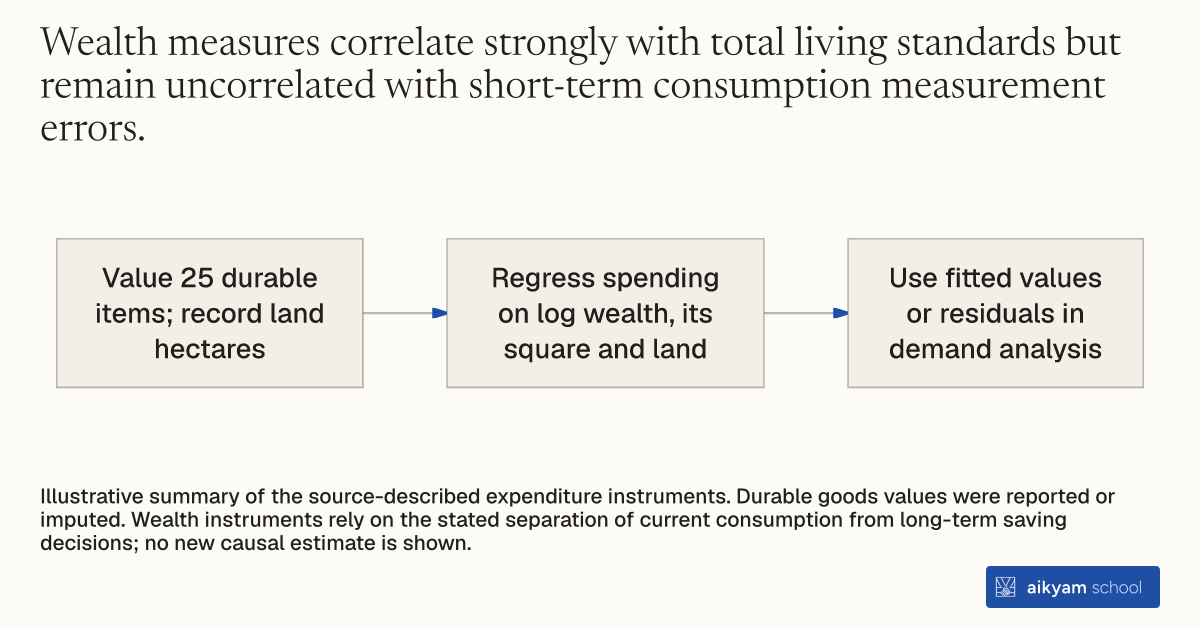
- Value 25 durable items; record land hectares
- Regress spending on log wealth, its square and land
- Use fitted values or residuals in demand analysis
Illustrative summary of the source-described expenditure instruments. Durable goods values were reported or imputed. Wealth instruments rely on the stated separation of current consumption from long-term saving decisions; no new causal estimate is shown.
See source →How
When to use
Evaluating demand systems requires estimating how budget shares change with total household expenditure. Total spending is often measured with survey error or reflects unobserved preference shocks that distort demand slope estimates. Instrumenting total non-durable expenditure with durable goods and land wealth addresses this endogeneity for poor welfare households.
Instrument total household expenditure using durable asset values and land wealth in first-stage demand regressions.
- Enumerators record household ownership across 25 durable asset items during evaluation surveys.
- Self-report or impute the monetary market value for each owned durable good item.
- Sum individual asset values to compute total durable wealth and create a squared durable wealth term.
- Measure the total area of land owned by the household in hectares.
- Regress total non-durable expenditure on log durable wealth, squared log durable wealth, and land area.
- Extract fitted values or first-stage residuals to control for expenditure endogeneity in the demand system.
Why it works
Wealth assets remain valid instruments when period consumption decisions are separable from long-term savings choices.
Example
In Macedonia, researchers instrumented total non-durable expenditure for 811 households using land owned and a quadratic in log durable asset values. First-stage regressions yielded partial F-statistics of 26.3 for non-durable expenditure and 25.9 for food expenditure.
About the study
Participants
1053 households with children aged 14 to 18 sampled at baseline across 84 municipalities in Macedonia, with 830 households followed up after two years. Households averaged 4.5 members and 55 percent were Muslim.
Study Design
A randomized trial across all 84 municipalities in Macedonia, stratified by population size into 42 mother-recipient municipalities and 42 household-head-recipient municipalities. First-stage linear regressions instrumented non-durable and food log expenditure using land area in hectares and quadratic log durable wealth.
Results
First-stage regressions produced a partial F-statistic of 26.326 for total non-durable expenditure and 25.989 for food expenditure. Addressing expenditure endogeneity confirmed that mother-targeted cash transfers increased the food budget share intercept by 5.63 percentage points.