Research steps
Use vouchers to estimate insurance effects
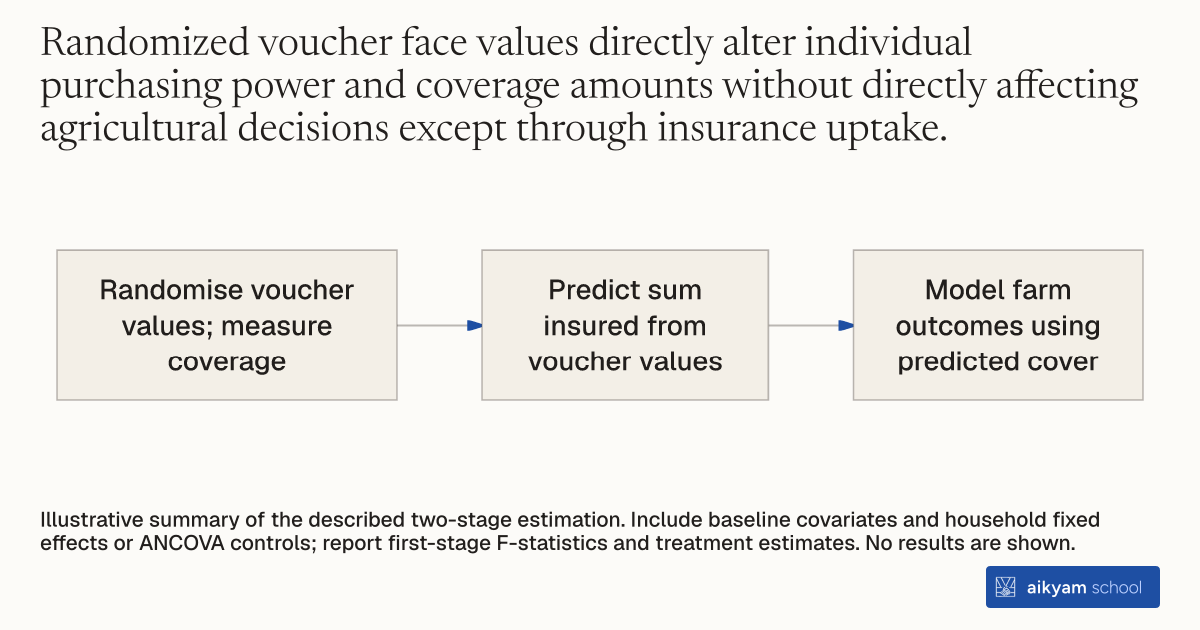
- Randomise voucher values; measure coverage
- Predict sum insured from voucher values
- Model farm outcomes using predicted cover
Illustrative summary of the described two-stage estimation. Include baseline covariates and household fixed effects or ANCOVA controls; report first-stage F-statistics and treatment estimates. No results are shown.
See source →How
When to use
Direct insurance uptake is endogenously chosen by farmers based on unobserved risk preferences and wealth, confounding standard ordinary least squares estimates of insurance impact. Estimating the true local average treatment effect of sum insured requires an exogenous driver of coverage levels. Instrumental variables estimation uses randomized discount voucher face values as exogenous instruments to isolate the causal impact of insurance sum insured on agricultural outcomes.
Estimate the causal effect of insurance sum insured on agricultural choices using randomized voucher face values as instrumental variables in a two-stage least squares framework.
- Randomly assign discount vouchers of varying monetary face values to individual households to create exogenous variation in policy purchasing power.
- Measure the total sum insured chosen and purchased by each household in the post-treatment sales wave.
- Formulate the first-stage regression equation predicting household sum insured as a function of assigned voucher face values and exogenous baseline covariates.
- Estimate the second-stage structural regression modeling agricultural inputs or yields on instrumented values of sum insured.
- Apply panel household fixed effects or analysis of covariance controls to improve second-stage estimation precision.
- Report two-stage least squares treatment coefficients and first-stage F-statistics to verify instrument strength.
Why it works
Using two-stage least squares eliminates omitted variable bias caused by unobserved farmer risk aversion or baseline wealth.
Example
Researchers instrumented household sum insured using randomized discount voucher values worth up to 500 Birr across 882 Ethiopian farming households, finding that an additional 1,000 Birr of insurance coverage produced no significant change in chemical fertilizer use (+0.54 kg, p > 0.1).
About the study
Participants
882 panel cooperative farming households across 49 villages in Amhara Region, Ethiopia.
Study Design
Two-stage least squares instrumental variables regression with panel household fixed effects, instrumenting sum insured with assigned voucher face value tiers.
Results
Voucher assignment strongly predicted sum insured in the first stage (\$39.23 increase per voucher tier, p < 0.01), but instrumented sum insured showed no statistically significant effect on chemical fertilizer adoption (+0.54 kg per 1,000 Birr insured, p > 0.1) or crop yields.