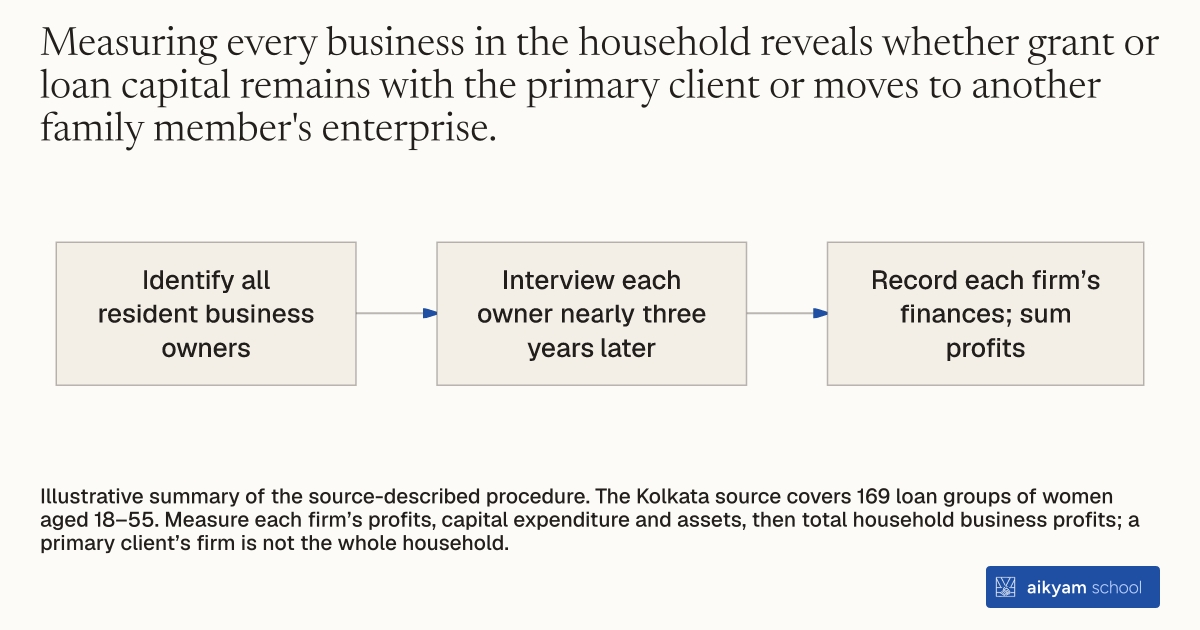
Research steps
Survey every household enterprise
- Identify all resident business owners
- Interview each owner nearly three years later
- Record each firm’s finances; sum profits
Illustrative summary of the source-described procedure. The Kolkata source covers 169 loan groups of women aged 18–55. Measure each firm’s profits, capital expenditure and assets, then total household business profits; a primary client’s firm is not the whole household.
See source →How
When to use
Evaluators measuring returns to capital often survey only individual loan recipients or grant targets. This single-business approach misses capital transfers to other family members' firms in multi-enterprise households. Research teams use intra-household multi-enterprise surveys to collect complete profit and capital data from every business operating within a household.
Survey every business owner living within target client households to capture full enterprise dynamics.
- Identify all micro-entrepreneurs residing within each client household during intake.
- Schedule household survey visits nearly three years after financial interventions occur.
- Interview each self-employed business owner within the household individually.
- Record specific business profits, capital expenditures, and asset investments for every separate firm.
- Aggregate firm-level financial metrics to calculate total household business profits.
Why it works
This captures hidden financial returns that standard single-firm surveys overlook.
Example
In Kolkata, India, researchers surveyed every business owner across sample households nearly three years after loan disbursements, discovering that grace period contracts increased total household business profits by 45 percent even when female-run firm profits showed no average increase.
About the study
Participants
169 loan groups of female micro-entrepreneurs aged 18 to 55 in Kolkata, India.
Study Design
Randomized evaluation collecting follow-up survey data from every business owner in sample households nearly three years post-disbursement.
Results
Surveying all household businesses revealed that a two-month grace period increased overall household business profits by around 45 percent, and increased business profits by around 75 percent for female clients who were sole entrepreneurs.