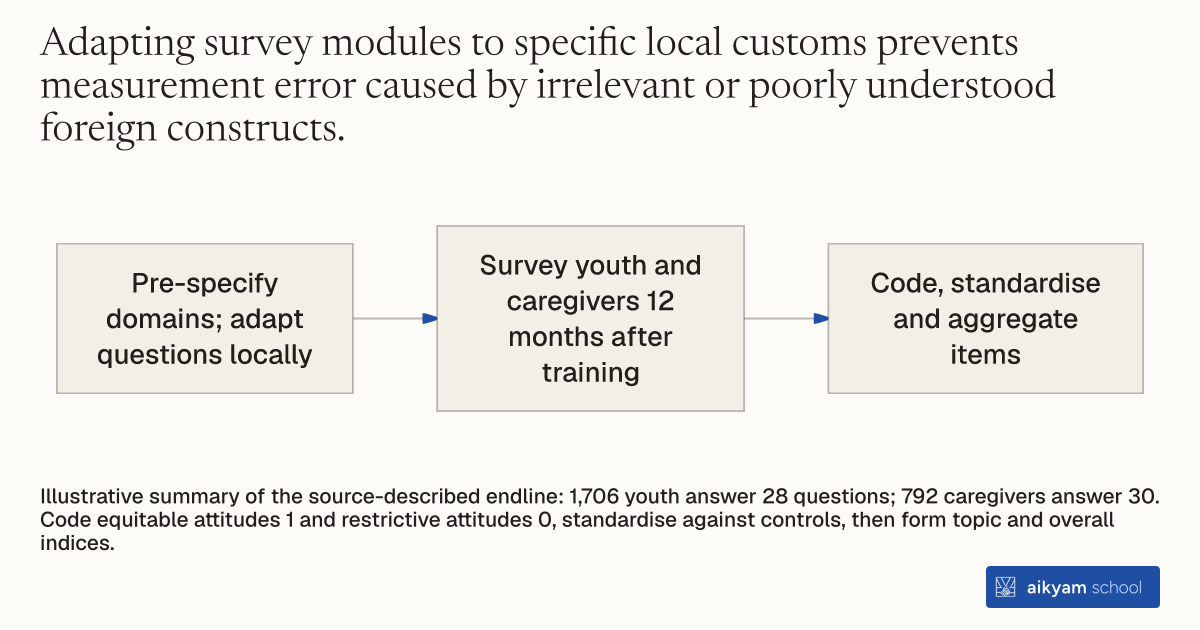
Research steps
Build context-adapted gender attitude indices
- Pre-specify domains; adapt questions locally
- Survey youth and caregivers 12 months after training
- Code, standardise and aggregate items
Illustrative summary of the source-described endline: 1,706 youth answer 28 questions; 792 caregivers answer 30. Code equitable attitudes 1 and restrictive attitudes 0, standardise against controls, then form topic and overall indices.
See source →How
When to use
Standardized survey instruments often fail to capture culturally nuanced gender dynamics in conservative religious environments. Unadapted questions risk missing localized constraints like female seclusion or specific guardian permissions. Constructing context-adapted multi-domain indices allows researchers to measure subtle shifts in attitudes regarding decision-making, social roles, and domestic responsibilities.
Measure changes in social and gender attitudes using a pre-specified multi-domain survey index tailored to local cultural practices.
- Formulate survey questions covering distinct domains including household decision-making, women's role in society, female labor force participation, and domestic violence.
- Adapt standard survey modules to include specific local practices such as female seclusion (kulle) and guardian permissions for female work.
- Administer the survey instrument at endline to participating youth and their primary caregivers, including parents, husbands, and Quranic teachers.
- Binary-code individual response items so that equitable gender attitudes are assigned a value of one and restrictive attitudes zero.
- Standardize responses relative to the control group mean and standard deviation.
- Aggregate individual standardized items into topic sub-indices and an overall mean effects index following Kling et al. (2007).
Why it works
Aggregating individual items into standardized mean effect indices increases statistical power while reducing false discovery rates across multiple outcome comparisons.
Example
At endline, 12 months post-training, researchers administered a pre-specified 28-question gender norms survey module to 1,706 youth and a 30-question module to 792 caregivers in Northern Nigeria. The youth survey measured views on household decision-making, women's role in society, and domestic violence, while the caregiver survey evaluated attitudes toward female labor supply and decision-making authority.
About the study
Participants
1,706 youth aged 15 to 24 and 792 primary caregivers across Kaduna and Katsina states, Northern Nigeria.
Study Design
Endline survey administered 12 months after 9 months of vocational training, aggregating standardized binary items into mean effects indices using control group distribution.
Results
Exposure to vocational training increased the youth gender norms index by 0.120 standard deviations and increased the caregiver gender norms index by 0.163 standard deviations.