Research procedure
Describe family-based plant delegation
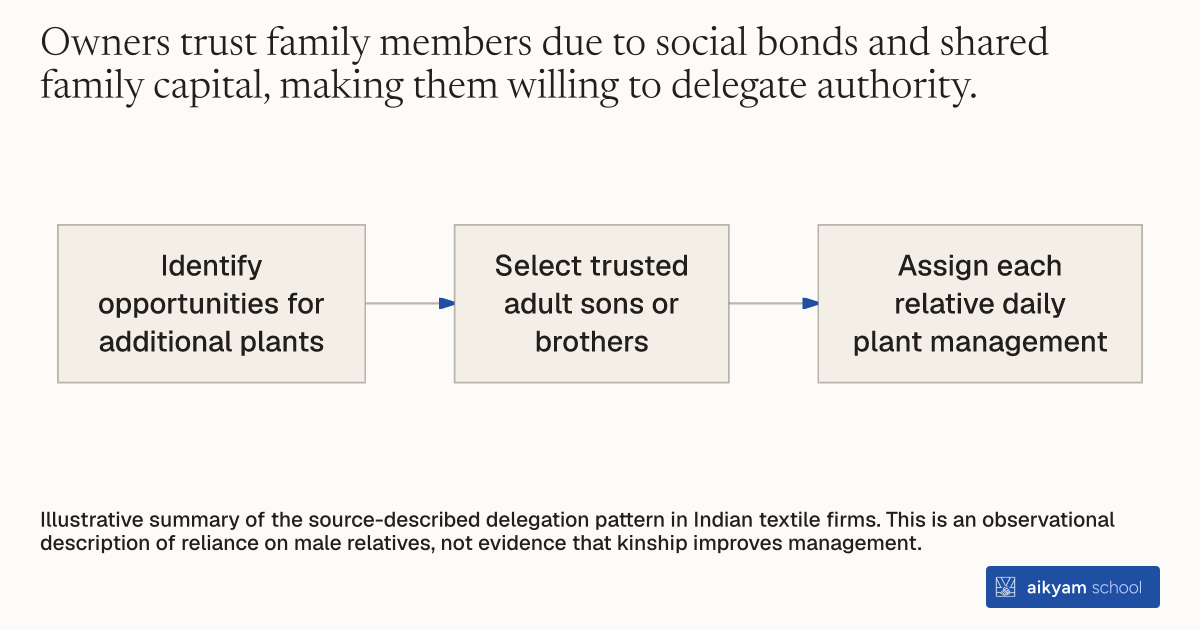
- Identify opportunities for additional plants
- Select trusted adult sons or brothers
- Assign each relative daily plant management
Illustrative summary of the source-described delegation pattern in Indian textile firms. This is an observational description of reliance on male relatives, not evidence that kinship improves management.
See source →How
When to use
Enterprise owners in developing countries fear theft by non-family managers due to weak legal systems. Centralized control limits firm growth because owners run out of personal time. This method delegates plant management to trusted male family relatives when professional managers cannot be hired.
Delegate factory management positions selectively to trusted male family members.
- Enterprise owners evaluate firm growth opportunities and identify new plant locations.
- Owners select adult sons and brothers to manage additional factory sites.
- Owners assign operational authority and day-to-day oversight of each plant to a family relative.
- Relatives run daily factory operations without fear of owner legal action or distrust.
Why it works
This allows owners to expand beyond a single production site without fearing managerial theft.
Example
Large Indian textile manufacturing firms expanded by opening new production plants only when trusted male relatives were available. Firms with owners who had multiple brothers and sons grew significantly larger than firms with zero brothers or sons.
About the study
Participants
Large Indian textile manufacturing plants in the BEMMR study with a median asset value of 13.3 million dollars.
Study Design
Observational field study measuring firm size, plant count, and family demographics of enterprise owners.
Results
The number of owner brothers and sons directly predicted total firm size and plant expansion counts across Indian manufacturing plants.