Research procedure
Track shop voucher redemptions
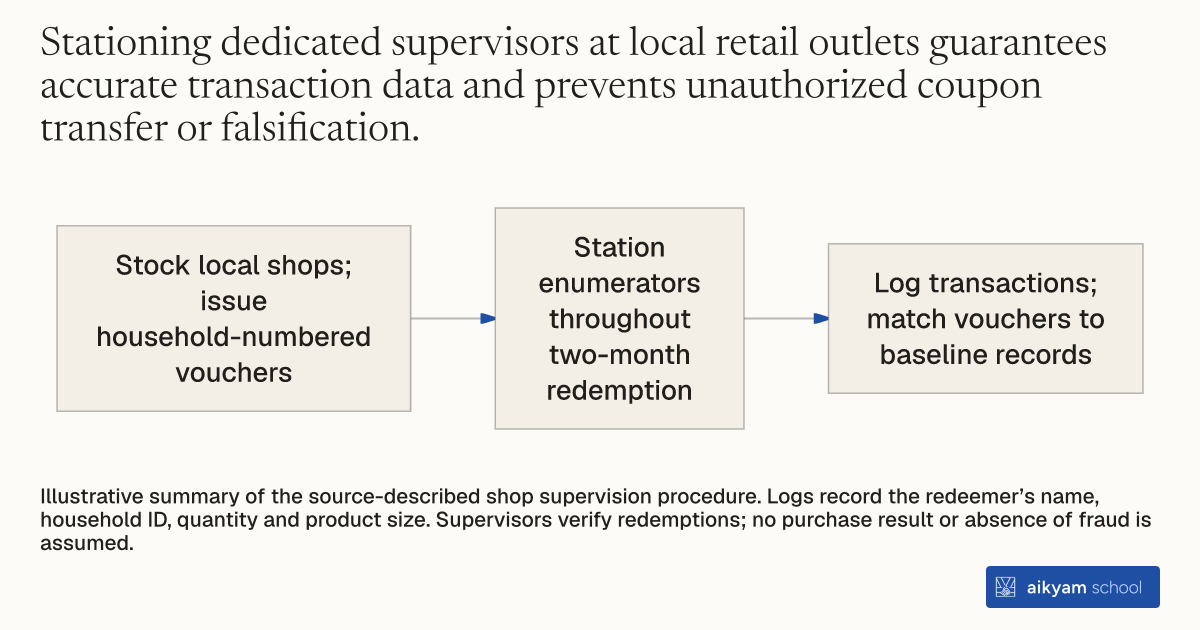
- Stock local shops; issue household-numbered vouchers
- Station enumerators throughout two-month redemption
- Log transactions; match vouchers to baseline records
Illustrative summary of the source-described shop supervision procedure. Logs record the redeemer’s name, household ID, quantity and product size. Supervisors verify redemptions; no purchase result or absence of fraud is assumed.
See source →How
When to use
Field programs distributing discount vouchers often struggle to track individual product redemption and prevent voucher fraud across local merchants. Use this method when distributing subsidized health products through established local commercial markets. It applies to evaluators who need precise administrative purchase records without setting up separate program-run distribution channels.
Partner with local market shops and station dedicated field supervisors to verify voucher redemptions and maintain administrative sales logs.
- Identify established local market shops located within regular community shopping distances.
- Supply participating local retail shops with adequate inventory of the subsidized health product.
- Issue households discount vouchers pre-printed with unique household identification numbers.
- Station a trained field enumerator at each partner retail shop throughout the two-month redemption period.
- Record every transaction in an administrative log, noting the redeemer's name, household ID, quantity redeemed, and product size.
- Match collected vouchers and administrative logs back to baseline survey records.
Why it works
Using existing local shops grounds the distribution in familiar commercial settings while ensuring complete data tracking for impact analysis.
Example
In Busia and Samia Districts of Western Kenya, field teams partnered with local market shops located roughly 1.5 kilometers from sampled households and stationed enumerators to track shoe voucher redemptions over a two-month period.
About the study
Participants
999 surveyed households in Busia and Samia Districts of Western Kenya, living on roughly \$1 per day.
Study Design
Administrative store supervision tracking redemptions of discount vouchers (priced 5 to 65 Ksh) for children's shoes across local market shops over a two-month window.
Results
Dedicated store enumerators logged redemption decisions across 999 households, capturing purchase rates ranging from 93% at 5 Ksh to 42% at 65 Ksh with minimal administrative loss.