Research procedure
Sample active female savers
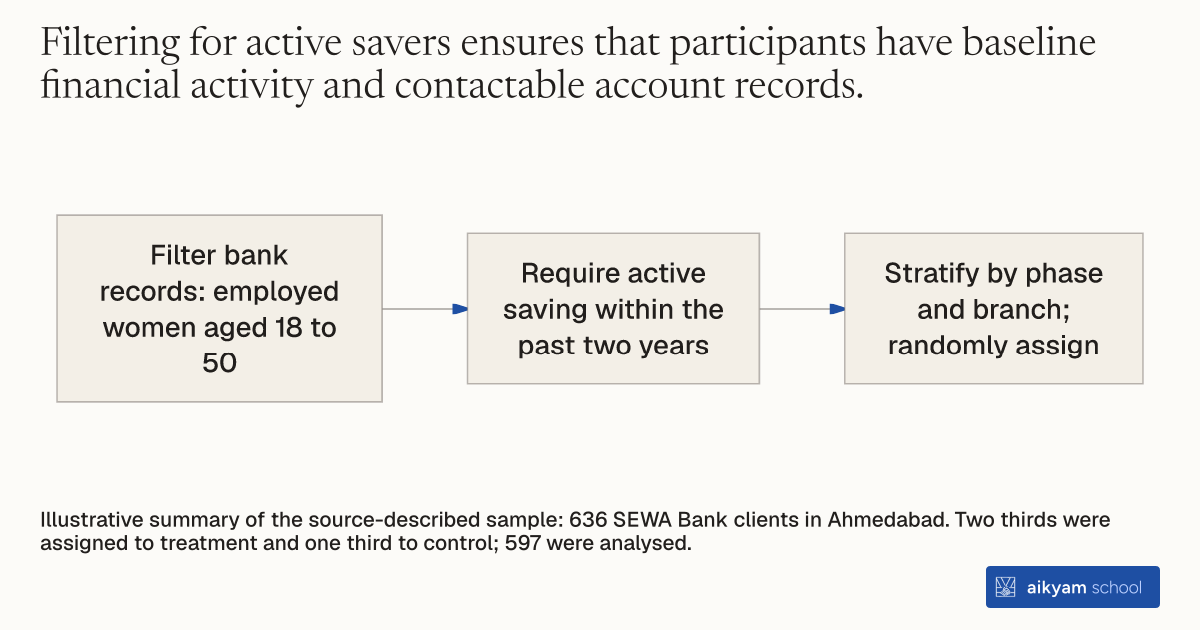
- Filter bank records: employed women aged 18 to 50
- Require active saving within the past two years
- Stratify by phase and branch; randomly assign
Illustrative summary of the source-described sample: 636 SEWA Bank clients in Ahmedabad. Two thirds were assigned to treatment and one third to control; 597 were analysed.
See source →How
When to use
When designing a field experiment for microfinance clients, researchers need a study population with baseline economic engagement. Filtering by active account status avoids selecting dormant or unreachable clients and ensures a sample of working micro-entrepreneurs.
Select study participants by filtering administrative client databases for active account status and randomizing within branches.
- Obtain the complete customer database from a partner microfinance bank in the target region.
- Restrict the sampling frame to female clients aged 18 to 50 who held active savings accounts within the past two years and reported being employed.
- Stratify the eligible client list by sampling phase and local bank branch location.
- Draw a random sample of clients from the stratified frame to assign to experimental arms.
- Randomly allocate two thirds of the selected participants to the treatment group and one third to the control group.
Why it works
Stratifying by branch and phase maintains balance across geographic service areas and rollout timelines.
Example
In Ahmedabad, India, researchers drew 636 female SEWA Bank customers aged 18 to 50 who were active savers within the past two years and employed, randomly assigning two thirds to receive business training across bank branches.
About the study
Participants
N = 636 female microfinance clients (597 analyzed: 346 Upper Caste, 70 Scheduled Caste, 181 Muslim) aged 18 to 50 in Ahmedabad, India.
Study Design
Randomized sampling stratified by sampling phase and bank branch, assigning two thirds to treatment and one third to control with a 5.3% survey attrition rate.
Results
The sampling frame yielded a balanced evaluation panel of 597 micro-entrepreneurs across sub-castes with baseline survey completion rates exceeding 94%.