Research procedure
Track informal firm finances
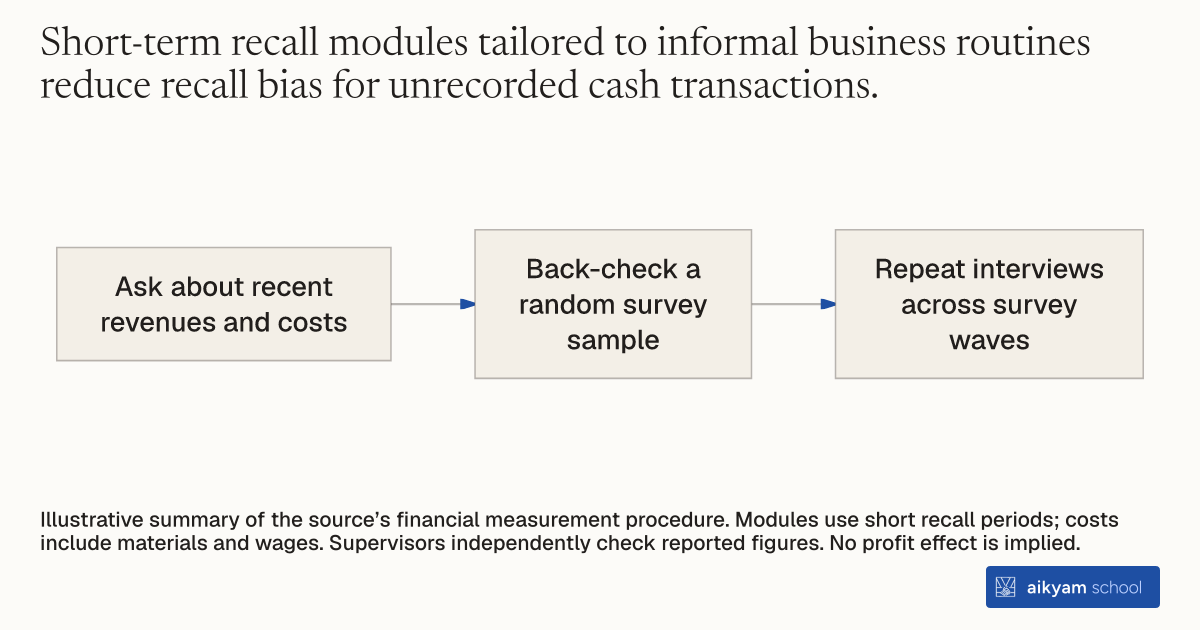
- Ask about recent revenues and costs
- Back-check a random survey sample
- Repeat interviews across survey waves
Illustrative summary of the source’s financial measurement procedure. Modules use short recall periods; costs include materials and wages. Supervisors independently check reported figures. No profit effect is implied.
See source →How
When to use
Microenterprises in developing nations rarely maintain formal financial ledgers or accounting records, making accurate profit measurement difficult. Program evaluators need a reliable methodology to measure firm revenue, expenses, and profits without relying on formal balance sheets. Utilizing structured recall modules combined with supervisor verification back-checks captures informal enterprise financial dynamics accurately.
Measure informal enterprise financial performance using repeated recall modules and supervisor back-checks.
- Survey informal enterprise owners using standardized questionnaire modules that capture monthly revenues, material input costs, and employee wage bills.
- Structure revenue and expense questions around specific short-term recall periods to minimize memory errors among unbanked microenterprise owners.
- Conduct independent supervisor back-checks on a random sample of completed enterprise surveys to cross-verify reported financial figures.
- Re-interview enterprise owners across multiple survey waves to track longitudinal changes in net profits and operating value.
Why it works
Supervisor back-checks provide audit mechanisms that detect survey errors and discourage misreporting.
Example
Evaluators in Côte d'Ivoire measured financial performance across 674 informal microenterprises (67 percent without written accounts) at midline, finding treatment firms generated 32,115 FCFA more in monthly apprentice work value while overall enterprise net profits remained statistically unchanged due to supervisory time costs.
About the study
Participants
674 informal micro and small enterprises evaluated at 20-month midline across 7 urban localities in Côte d'Ivoire.
Study Design
Longitudinal enterprise survey using repeated short-term recall modules and randomized supervisor back-checks to track business performance across treatment arms.
Results
Repeated financial measurement showed that host enterprises increased monthly gross apprentice work value by 32,115 FCFA (p < 0.01) and net apprentice work value by 21,380 FCFA (p = 0.0003), while overall firm net profits showed no statistically significant change (-15,082 FCFA, p = 0.505).