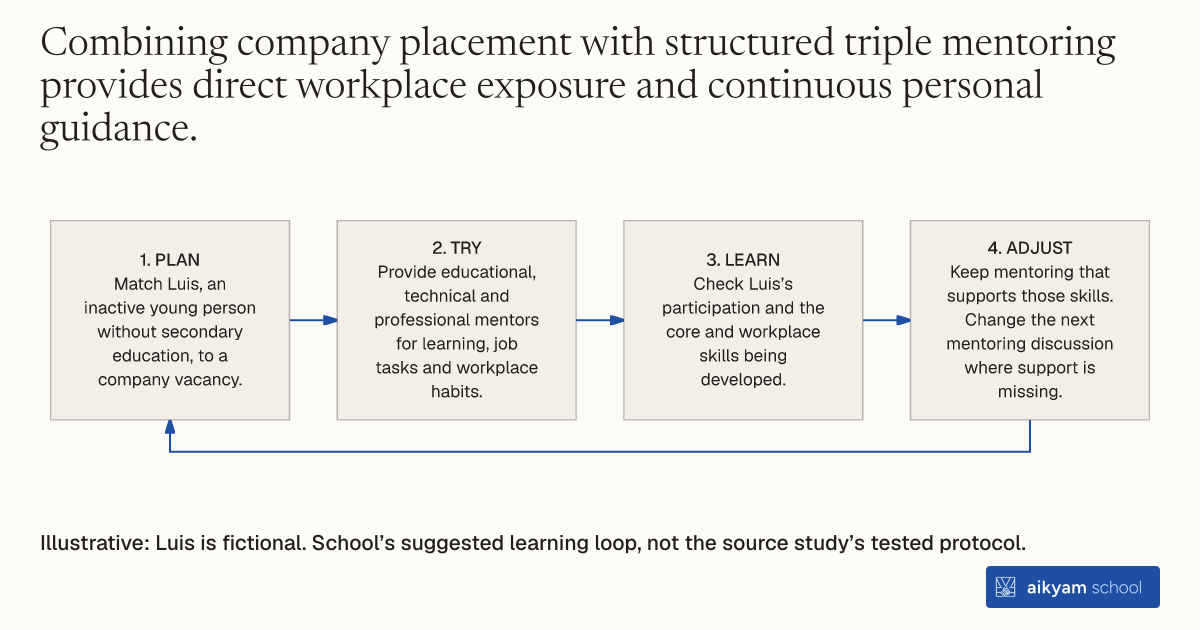
Try, learn and adjust
Check apprenticeship mentoring support
- Plan: Match Luis, an inactive young person without secondary education, to a company vacancy.
- Try: Provide educational, technical and professional mentors for learning, job tasks and workplace habits.
- Learn: Check Luis’s participation and the core and workplace skills being developed.
- Adjust: Keep mentoring that supports those skills. Change the next mentoring discussion where support is missing.
Illustrative: Luis is fictional. School’s suggested learning loop, not the source study’s tested protocol.
See source →School’s suggested learning loop, not the source’s tested procedure. Observe participation and skills. The source reports no increase in short-term employment or further education enrolment.
How
When to use
Inactive youth without secondary education face severe difficulties entering the labor market due to a lack of work experience and foundational skills. Standard classroom training without workplace exposure often fails to prepare vulnerable young people for job vacancies. This method pairs young job seekers with triple-mentor workplace apprenticeships to build core and transversal skills.
Assign inactive youth to workplace job vacancies supported by educational, technical, and professional mentors over five months.
- Program caseworkers recruit inactive youth who have not completed secondary education into the apprenticeship scheme.
- Coordinators match each youth participant to an open job vacancy in a partner firm.
- An educational mentor provides guidance to support the participant's foundational learning and study habits.
- A technical mentor inside the company delivers hands-on instruction on specific job duties and operational tasks.
- A professional mentor inside the company offers ongoing workplace coaching to build professional habits and teamwork skills.
Why it works
Multi-layered support helps disadvantaged youth develop core self-control and transversal workplace skills in a real professional environment.
Example
The Government of Madrid implemented a five-to-six-month apprenticeship program for 421 inactive youth without secondary education in Madrid, Spain. Participants received support from educational, technical, and professional mentors while placed in company job vacancies, achieving a 91 percent take-up rate. The intervention enhanced participants' core skills and transversal competencies, though it did not increase short-term employment or educational enrollment.
About the study
Participants
421 inactive youth without completed secondary education (211 treatment group, 210 comparison group) in Madrid, Spain.
Study Design
Randomised Controlled Trial (RCT) evaluating a 5-to-6-month triple-mentored apprenticeship training program implemented by the Government of Madrid.
Results
The program enhanced participants' core skills (self-confidence, self-control, communication, compliance, digital literacy) and transversal skills (flexibility, teamwork, frustration tolerance, self-organization, goal orientation, problem-solving), with a 91 percent take-up rate and an 8 percent attrition rate, but did not increase short-term employment or further education enrollment.