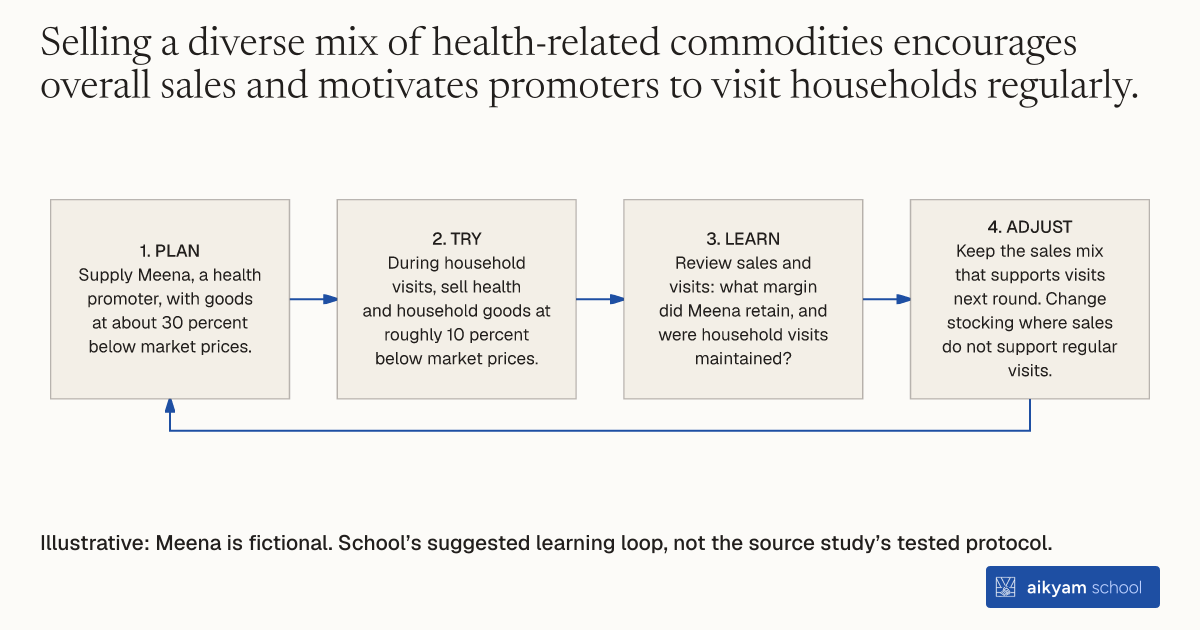
Try, learn and adjust
Check promoter sales support household visits
- Plan: Supply Meena, a health promoter, with goods at about 30 percent below market prices.
- Try: During household visits, sell health and household goods at roughly 10 percent below market prices.
- Learn: Review sales and visits: what margin did Meena retain, and were household visits maintained?
- Adjust: Keep the sales mix that supports visits next round. Change stocking where sales do not support regular visits.
Illustrative: Meena is fictional. School’s suggested learning loop, not the source study’s tested protocol.
See source →School’s suggested, untested loop. Observe wholesale costs, sale prices, retained margins and visits. This suggested loop is not a medicine-dispensing protocol.
How
When to use
Unpaid community health workers often experience low motivation and supply shortages, limiting their ability to regularly distribute health supplies to rural households. Micro-entrepreneurial commodity sales allow health promoters to earn a modest income while distributing both preventive and curative health items at affordable prices.
Establish a door-to-door sales model with discounted wholesale purchasing and cross-subsidized health product lines.
- Non-governmental organizations supply health promoters with health products at wholesale prices about 30 percent below market rate.
- Promoters stock high-demand commercial goods such as soap, cookstoves, and solar lights alongside preventive health items like bed nets and water purification tablets.
- Promoters stock low-margin curative medical treatments including oral rehydration salts, zinc, and antimalarial drugs.
- Promoters carry product baskets during regular door-to-door visits to households in rural target villages.
- Promoters resell commodities to villagers at roughly 10 percent below market rate, earning a modest profit margin to cross-subsidize health services.
Why it works
Carrying high-demand goods funds regular visitation, which drives up product adoption and makes life-saving items accessible.
Example
Living Goods and BRAC Uganda provided health promoters across 115 Ugandan villages with health commodities purchased wholesale at 30 percent below market rate, enabling promoters to resell at 10 percent below market rate and support a 27 percent drop in under-five child mortality across 7,000 households.
About the study
Participants
214 rural villages (115 treatment and 99 comparison) covering about 7,000 households and over 11,000 children in Uganda.
Study Design
Randomized controlled trial evaluating program impact after three years using household surveys and Poisson rate ratio empirical models.
Results
Child mortality fell by 27 percent (48.5 vs 68.4 per 1,000 births), water treatment reached 81.2 percent vs 77.4 percent, bed net usage reached 45.3 percent vs 40.2 percent, and ORS or zinc treatment reached 38.1 percent vs 32.8 percent.