Try, learn and adjust
Check savings groups follow contribution and loan rules
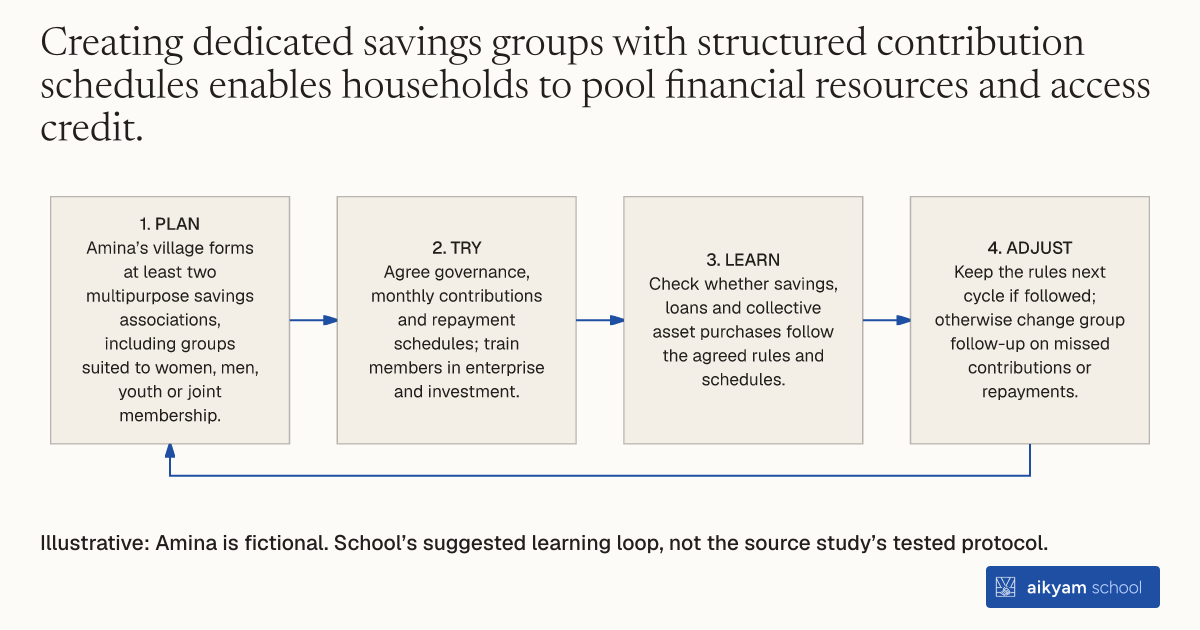
- Plan: Amina’s village forms at least two multipurpose savings associations, including groups suited to women, men, youth or joint membership.
- Try: Agree governance, monthly contributions and repayment schedules; train members in enterprise and investment.
- Learn: Check whether savings, loans and collective asset purchases follow the agreed rules and schedules.
- Adjust: Keep the rules next cycle if followed; otherwise change group follow-up on missed contributions or repayments.
Illustrative: Amina is fictional. School’s suggested learning loop, not the source study’s tested protocol.
See source →School’s suggested, untested learning loop. Observe group rules, contributions and repayments; no savings or asset gain is assumed.
How
When to use
Rural households in low-income regions often lack access to formal banking and financial services, making it difficult to save money or secure loans for large purchases. Forming community-managed savings and loan associations creates structured local financial mechanisms. This method is intended for rural agricultural communities seeking to build savings, acquire livestock, and fund small businesses.
Establish multi-purpose Village Savings and Loan Associations to provide community members with structured savings and credit mechanisms.
- Require each target village to form at least two Village Savings and Loan Associations dedicated to business creation, livestock purchases, or asset purchases.
- Form distinct groups catering to demographic needs, including separate groups for women, men, and youth, as well as joint groups.
- Establish group governance rules that enable associations to accumulate savings, issue loans to individual members, and collectively purchase assets.
- Set required monthly contribution amounts and structured loan repayment schedules for all participating members.
- Provide training on business creation, investment, business funding, marketing, and performance monitoring to support enterprise development.
Why it works
Forming larger, higher-quality groups allows members to make substantial purchases of productive livestock, farm tools, and business assets.
Example
In rural western Uganda, Raising the Village required treated villages to set up at least two multi-purpose savings associations, increasing household group membership rates by 7 percentage points and raising total savings by USD 61.63 PPP per household.
About the study
Participants
3,852 households across 335 villages in Kagadi and Kyenjojo districts, western Uganda, where 35% of households fall below the \$2.15 PPP daily poverty line post-harvest and 65% during the lean season.
Study Design
Clustered randomized controlled trial across 114 village clusters covering 335 villages, comparing a universal livelihoods program to a pure control group.
Results
Group participation increased by 0.069 (7 percentage points, p < 0.01) over a 65% control mean, total savings increased by USD 61.63 PPP (30%, p < 0.01), value of own savings in groups rose by USD 45.106 PPP (27%, p < 0.01), group size increased by 3.073 members (p < 0.01), and group likelihood of issuing loans or owning assets increased by 0.100 (p < 0.01).