Research steps
Sample tailors within urban neighbourhoods
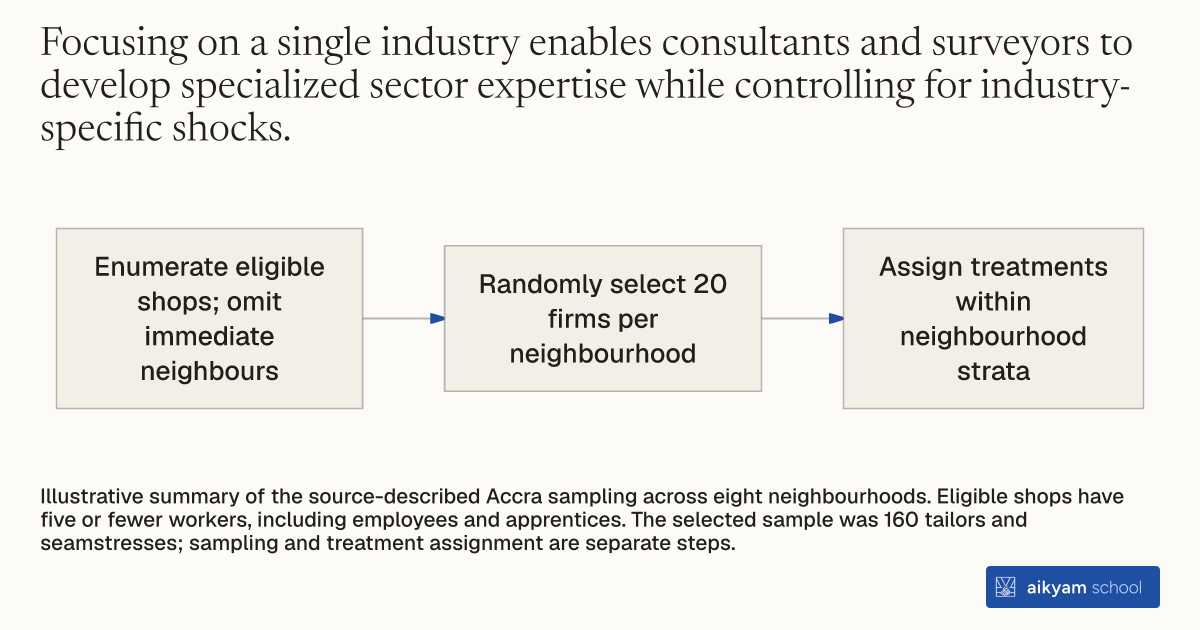
- Enumerate eligible shops; omit immediate neighbours
- Randomly select 20 firms per neighbourhood
- Assign treatments within neighbourhood strata
Illustrative summary of the source-described Accra sampling across eight neighbourhoods. Eligible shops have five or fewer workers, including employees and apprentices. The selected sample was 160 tailors and seamstresses; sampling and treatment assignment are separate steps.
See source →How
When to use
Evaluating microenterprise development requires selecting a clear, representative sample of small businesses within a single industry. Mapping specific urban neighborhoods identifies microenterprises of varying sizes while avoiding geographical overlap between study groups. This method serves research teams building sample frames for randomized trials in urban informal markets.
Enumerate informal microenterprises across urban neighborhoods and select participants using stratified random sampling.
- Select a single urban industry displaying continuous firm size variation from solo operators to multi-worker shops across a city.
- Choose a set of urban neighborhoods containing sufficient concentrations of target microenterprises to reduce survey travel costs.
- Conduct an exhaustive door-to-door enumeration mapping every qualifying business with five or fewer workers in the chosen neighborhoods.
- Omit immediate neighboring shops from the enumeration to prevent information spillovers between treatment and control subjects.
- Randomly select twenty eligible microenterprises per neighborhood to form a balanced sample frame.
- Stratify participant assignments to treatment groups by neighborhood to maintain geographical balance across experimental arms.
Why it works
Stratifying randomization by neighborhood ensures balanced geographic distribution and prevents localized economic spillovers from distorting control groups.
Example
Researchers mapped tailors and seamstresses across eight neighborhoods in Accra, Ghana, selecting 20 firms per neighborhood with five or fewer workers. The team enumerated 160 tailors with zero firm refusals, randomly assigning participants to consulting and cash grant treatment arms stratified by neighborhood.
About the study
Participants
160 urban microenterprise tailors and seamstresses (35% solo operators, 94% with three or fewer workers) across eight neighborhoods in Accra, Ghana.
Study Design
Exhaustive door-to-door neighborhood census and individual-level randomized assignment stratified by neighborhood of operation across eight survey rounds over 24 months.
Results
Zero firms refused participation at baseline, 149 participants were successfully retained through Round 8 (7% attrition due to 5 deaths and 6 moves), and assignment to experimental arms was statistically orthogonal across baseline characteristics (F-statistic probabilities > 0.05).